Pleats Please
A garment-pleating revolution that proved technology and democratic design could be fashion's most radical act.
Most fashion innovations announce themselves through spectacle — an impossible silhouette, a forbidden material, a provocation designed to be photographed and argued about. Issey Miyake’s Pleats Please arrived in 1993 with a proposition so quiet it was almost inaudible: a permanently pleated polyester jersey garment that weighed almost nothing, never wrinkled, could be machine-washed, folded flat into a suitcase, and looked as precise after a transatlantic flight as it did on the hanger. The revolution was not in the form, which was simple — columnar dresses, tunics, trousers — but in the technology that made the form possible, and in the radical suggestion that the most advanced thing a garment could do was work. Not perform, not provoke, not signify. Work.
The development began not in a design studio but in a theater. In 1991, Miyake designed costumes for William Forsythe’s Ballett Frankfurt production “The Loss of Small Detail,” and the demands of dance — fabric that moved with the body, retained its shape through extreme motion, and could be laundered repeatedly without degradation — pushed his team toward a textile solution that would consume four years of research and trials before the commercial launch. The process they developed inverted the conventional relationship between cutting and pleating. Where traditional pleating is applied to flat fabric that is then cut and sewn, Miyake’s method required cutting and sewing the garment first, at approximately two and a half to three times the size of the finished piece. The oversized garment was then sandwiched between sheets of paper and hand-fed into a heat-press machine that exploited the thermoplastic properties of polyester to set permanent folds into the fabric. Miyake patented the technique in 1993, and it remains essentially unchanged three decades later — a fact that speaks less to the technique’s simplicity than to the precision with which it was developed. You cannot improve what was already exactly right.
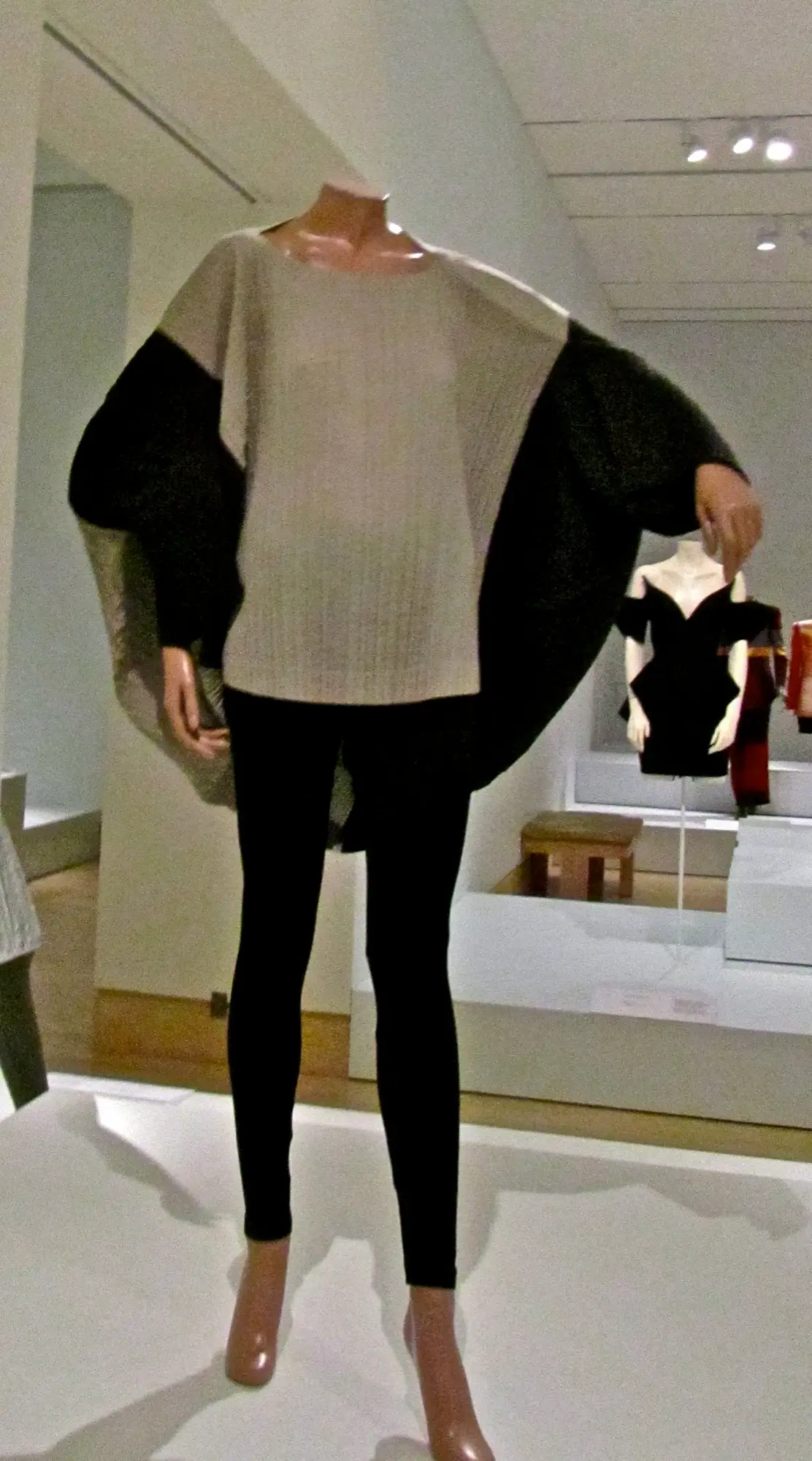
The garments themselves resist the vocabulary of fashion criticism. They have no construction details to admire, no seaming to analyze, no visible evidence of the hand that made them. They are, in the language of industrial design, elegant systems — solutions so complete that they appear to have no moving parts. The pleats create a micro-architecture within the fabric, a series of parallel folds that give the polyester jersey a spring-like resilience and a visual rhythm that shifts with every movement of the body. The fabric breathes because the pleats create channels of air between their folds. It drapes because the pleats distribute weight evenly across the garment’s surface. It packs flat and springs back because the heat-set folds have a material memory that outlasts any amount of compression. These are engineering achievements, but Miyake — who survived the Hiroshima bombing at the age of seven and spent his career insisting that design should look forward, never backward — understood them as something more: evidence that technology, properly directed, could produce beauty without scarcity, luxury without exclusion.
This was the political dimension of Pleats Please that its lightness and affordability tended to obscure. Miyake’s mainline collections occupied the highest reaches of fashion — conceptual, expensive, produced in limited quantities for a knowing audience. Pleats Please offered the same design intelligence at accessible price points, extending Miyake’s philosophy to a consumer base that had never been invited into the conversation. The decision was deliberate and, within the context of Japanese fashion in the 1990s, quietly radical. Kawakubo and Yamamoto, Miyake’s peers in the first wave of Japanese designers to reshape Paris, maintained the exclusivity that haute couture demanded. Miyake chose a different path, one that proposed democratic access as its own form of avant-garde practice. The garments were sold in their own dedicated retail spaces, hung on simple racks like items in a general store, and priced to be purchased without agonizing. The message was unmistakable: this is for you. All of you.
The line celebrated its thirtieth anniversary in 2023, the year after Miyake’s death on August 5, 2022, at the age of eighty-four. Thirty years of continuous production and continuous relevance is an achievement almost without parallel in contemporary fashion — most lines are lucky to survive a decade before the culture moves on, the technology is surpassed, or the commercial logic collapses. Pleats Please endures because it solved a problem that has not gone away and that no subsequent technology has solved better: how to make a garment that is simultaneously beautiful, functional, durable, and accessible. The Homme Plisse Issey Miyake line, which extended the pleating technology to menswear, and the broader influence on performance luxury — visible in everything from Uniqlo’s collaborations to the technical fabrics that now dominate activewear — confirm that Miyake’s innovation was not a product but a proof. He demonstrated that fashion’s future did not have to choose between technology and beauty, between accessibility and intelligence, between the garment as object and the garment as system. Pleats Please chose all of these at once, and in doing so it became the most quietly radical gesture in late-twentieth-century fashion — a revolution so well-engineered that it does not look like a revolution at all.