Stockman
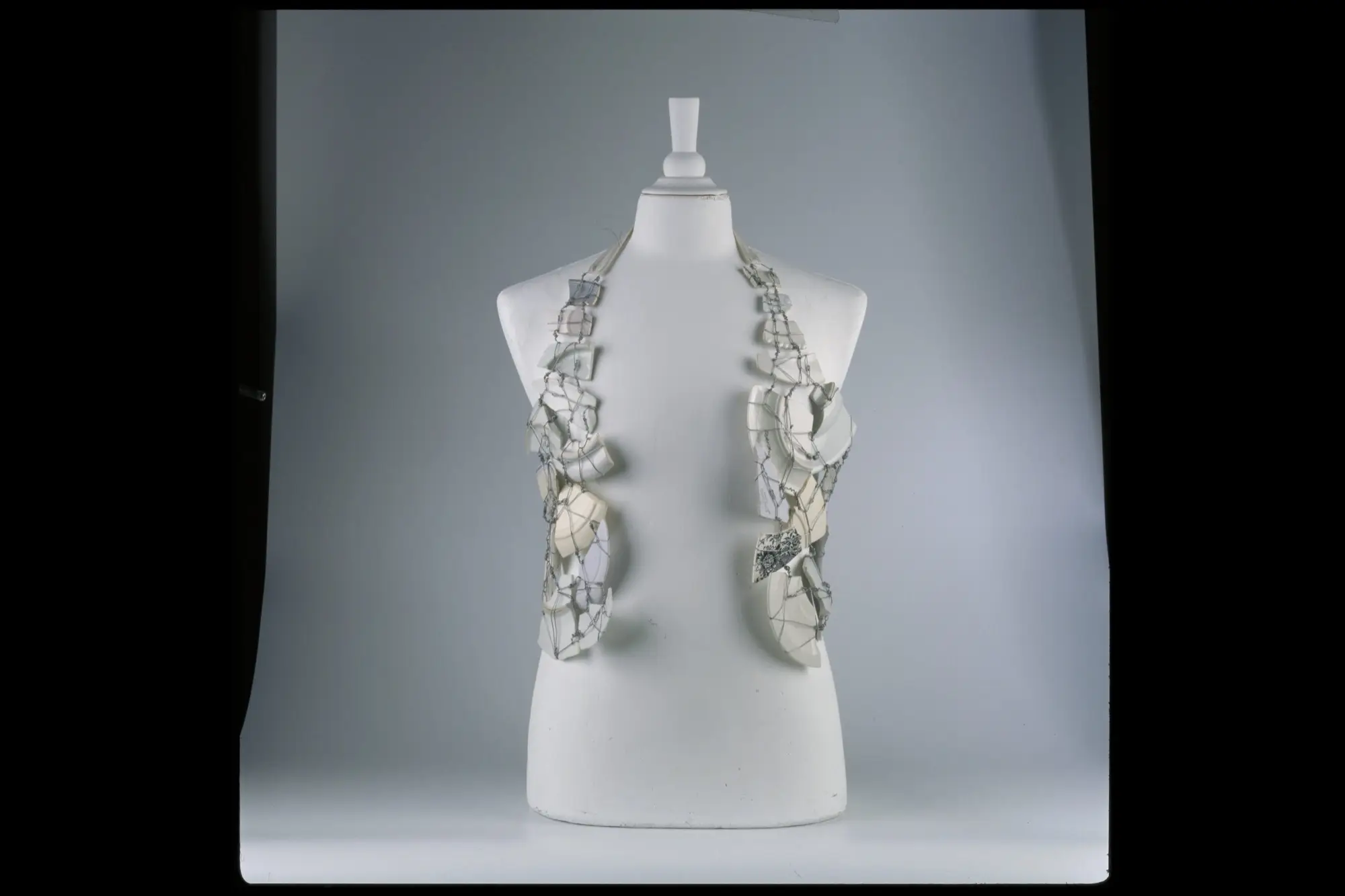
The Stockman is a dressmaker’s dummy — the armless, headless torso form around which garments are constructed in the ateliers of Paris, a tool so fundamental to the process of making clothes that it has become invisible, part of the furniture of fashion’s backstage that no one thinks to examine. For his Fall/Winter 1995 collection, Martin Margiela took this tool of the trade and turned it into the collection’s central motif, producing garments that appeared to have been designed not for the three-dimensional human body but for the flat, static surface of the mannequin. Vests and bodices replicated the Stockman’s shape exactly, their seams following the dummy’s contours rather than those of the person wearing them. The effect was uncanny: clothing that seemed to belong to nobody, that existed in a space between garment and pattern piece, between something finished and something still in the process of becoming.
The models moved through the space wearing these flat, planar garments, their faces covered in Margiela’s signature masks, and the contrast between the rigidity of the clothing and the softness and motion of the human frame produced a tension that was productive and strange. A deranging waltz played as the soundtrack, its formal elegance clashing with the conceptual severity of the garments in a way that suggested Margiela was deconstructing fashion’s rituals as much as its products — the show itself, with its music and its procession, was being subjected to the same interrogation as the garments. In a gesture that further dissolved the boundary between audience and spectacle, models sat among the guests during portions of the show, their presence blurring the line between spectator and participant, between the person who watches fashion and the person who wears it. Fabrics appeared in black, navy blue, hot pink, and red — a departure from the subdued palettes of earlier collections that suggested Margiela’s investigation was not aesthetic but structural, concerned not with surface but with the fundamental relationships between cloth, body, and the invisible infrastructure that mediates them.
This was Margiela at his most conceptually precise, and the collection has been described by critics as possibly his best and most radical body of work. The flat garments did not simply reference the tools of fashion production — they interrogated the fundamental assumption that clothing must conform to the body. What happens when the garment refuses to acknowledge the wearer’s form? What does it mean to wear something that was designed for an abstraction? These were not rhetorical questions. They were questions with material consequences, answered on the runway by the physical reality of women wearing garments that maintained their architectural flatness against the curvature and movement of living bodies. The garments did not accommodate the body; they proposed an alternative to it, suggesting that the human form is only one of the shapes clothing might inhabit, and perhaps not the most interesting one.
The Stockman concept would find its fullest expression in the Spring/Summer 1997 “semi-couture” collection, where Margiela draped fabric directly over the tailor’s forms, allowing the torso shape to become part of the clothing — parts of garments, half a back panel or a quarter of drapery, pinned onto a basic vest that modeled and evoked the Stockman form. On a base of white elastics, boning retained shards of silk muslin fabric onto linen, and the garments were presented as if still under construction, caught in the act of becoming, their incompleteness not a failure but a deliberate exposure of the process that fashion normally conceals. But the Fall/Winter 1995 collection was where the idea first crystallized, where the inanimate linen tailoring dummy took on new life as a jacket worn by real women, where the invisible armature of fashion’s production process stepped onto the runway and became, for the first time, a protagonist.
The collection also demonstrated Margiela’s gift for finding conceptual depth in fashion’s most mundane infrastructure. The tailor’s dummy, the lining, the label, the seam — these were the invisible elements that other designers took for granted, the things that existed only to serve the finished garment’s appearance, and they were precisely the elements Margiela found most interesting. His entire project, from the debut in 1989 through his departure in 2009, can be understood as a systematic excavation of fashion’s unconscious: the assumptions, habits, and hierarchies that structure the industry but are never themselves examined. The Stockman collection was the clearest articulation of this project, the moment at which Margiela demonstrated that the most radical thing a fashion designer could do was not to create something new but to make visible something that had always been there — the dummy on which the dress was made, the labor that preceded the luxury, the flatness that precedes the form. By 1995, the house had established a vocabulary of revelation: every collection found new ways to make the hidden visible, to turn the backstage into the show. The Stockman dummy, stripped of its utilitarian anonymity, became fashion’s most unlikely star — and in Margiela’s hands, the most eloquent argument that the process of making is as beautiful as the thing that is made.