The Café de la Gare Show
The venue was a children’s playground at the Cafe de la Gare in the twentieth arrondissement of Paris — not a salon, not a gallery, not any of the spaces where fashion was supposed to happen. The audience sat on borrowed chairs, first-come first-served, with no assigned seating for press or buyers — a radical departure from the rigid hierarchy that governed every other Paris show, where proximity to the runway was a measure of status and front-row placement a form of currency. Neighborhood children watched from the swings and climbed the equipment, their interactions with the models unrehearsed and uncontrolled, a chaos that would have horrified any other designer but that Margiela absorbed into the event as another layer of meaning. The models walked a runway that had been painted red, and as they moved, the wet paint transferred onto the soles of their shoes, leaving tracks that recorded the show’s own passage through time. This was Martin Margiela’s debut, and every detail was a declaration of war against the conventions of the industry he was entering.
The invitation had been a blank piece of fabric — no name, no logo, no information beyond the basic facts of location and time. The models’ faces were covered. The clothes themselves operated as arguments against the prevailing logic of late-1980s fashion, a period dominated by the extravagance of Christian Lacroix and the theatrical maximalism of Thierry Mugler and Claude Montana, designers for whom more was always more and luxury was measured in embellishment, in spectacle, in the visible expenditure of resources. Where the industry offered polish, Margiela offered process. Garments appeared deconstructed — seams visible, linings exposed, edges deliberately raw — but the construction was in fact exacting, the rawness a consequence of skill rather than its absence. The effect was not sloppiness but transparency: these were clothes that showed you how they were made, that refused the illusion that a finished garment arrives fully formed, without labor, without history.
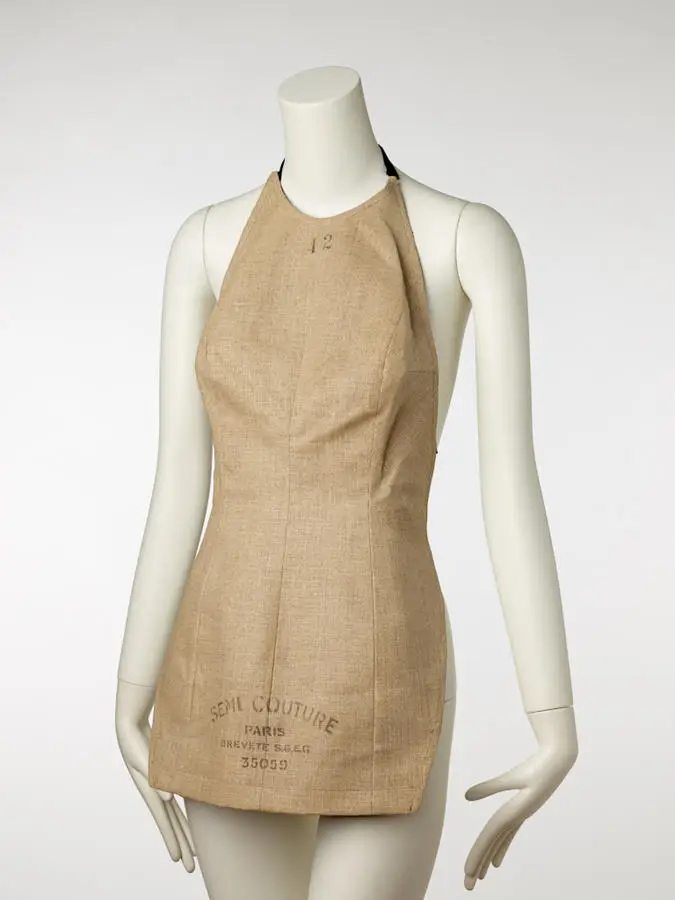
Vintage pieces had been taken apart and reassembled into new forms, an early articulation of the recycling and upcycling principles that would define the house’s Artisanal line and that predated the fashion industry’s sustainability discourse by nearly two decades. White and nude belted coats with frayed, unfinished edges carried an elegance that was inseparable from their imperfection. Wide-legged trousers moved with a fluidity that conventional tailoring, with its insistence on structure and crease, could not achieve. Carrier bag tops — garments constructed from the plastic bags of everyday commerce — collapsed the hierarchy between luxury material and waste material with a directness that was almost confrontational. A butcher’s apron was reconceived as an evening gown, the gesture simultaneously ironic and sincere, mocking fashion’s preciousness while demonstrating that beauty could be found in the most utilitarian of sources. Jackets were made from old tulle dresses, the fabric’s former life visible in its texture and wear, so that the new garment carried the memory of its previous incarnation like a ghost.
And then there were the Tabi boots. Adapted from the Japanese split-toed sock — a traditional garment worn with thonged sandals, functional, humble, historically invisible to Western fashion — rendered in leather with a cylindrical wooden heel, they were the single most provocative piece of footwear to appear in a Paris show in decades. The toe was divided like a cloven hoof, and as the models walked across the wet red paint of the runway, they left bifurcated prints — an image that was half joke, half manifesto, simultaneously playful and deeply unsettling, as if the models were not quite human. In 1988, Parisian footwear was governed by the stiletto and the pump, shoes designed to elongate the leg, to suggest elegance, to perform femininity according to established codes. The Tabi did none of these things. It made the foot look strange. It referenced a Japanese working-class garment at a moment when fashion’s cultural borrowing was confined to the decorative and the exotic. And the wooden heel clicked on the floor with a sound that did not belong in a fashion show. Everything about it was wrong, which is to say, everything about it was right.
The critics loathed it. The industry loved it. The polarization was immediate and productive, generating exactly the kind of conversation that Margiela needed: not consensus but argument, not admiration but interrogation. That same year, he won the first-ever ANDAM Award, France’s newly established prize for emerging designers, a recognition that the establishment could see the significance of what he was doing even as it struggled to accommodate it within existing frameworks of evaluation. Jenny Meirens, his co-founder and business partner, managed the commercial realities with a pragmatism that freed Margiela to pursue his conceptual program without compromise, and together they built a house that operated as both fashion label and ongoing critique of what fashion labels were supposed to be.
The Spring/Summer 1989 show established everything Margiela would spend the next two decades exploring: the unconventional venues, the anonymous presentation, the deconstruction as methodology rather than aesthetic, the conviction that fashion’s most interesting content is not what it shows but what it conceals. He never needed another beginning. The playground in the twentieth arrondissement was sufficient — a starting point so rich in implication, so thorough in its rejection of received wisdom, that an entire career could unfold from it. And it did. Every subsequent collection, from the Artisanal experiments to the Stockman investigations to the semi-couture provocations, was a continuation of the questions first posed on that red-painted runway: What is a garment? Who does it belong to? What happens when we take it apart? The Tabi boot, still in production at Maison Margiela more than three decades later, is the most visible legacy of that afternoon, but the deeper legacy is the permission the show granted to every designer who followed — the demonstration that fashion could be intelligent, self-critical, and genuinely subversive without ceasing to be beautiful.