Hiroshima Chic
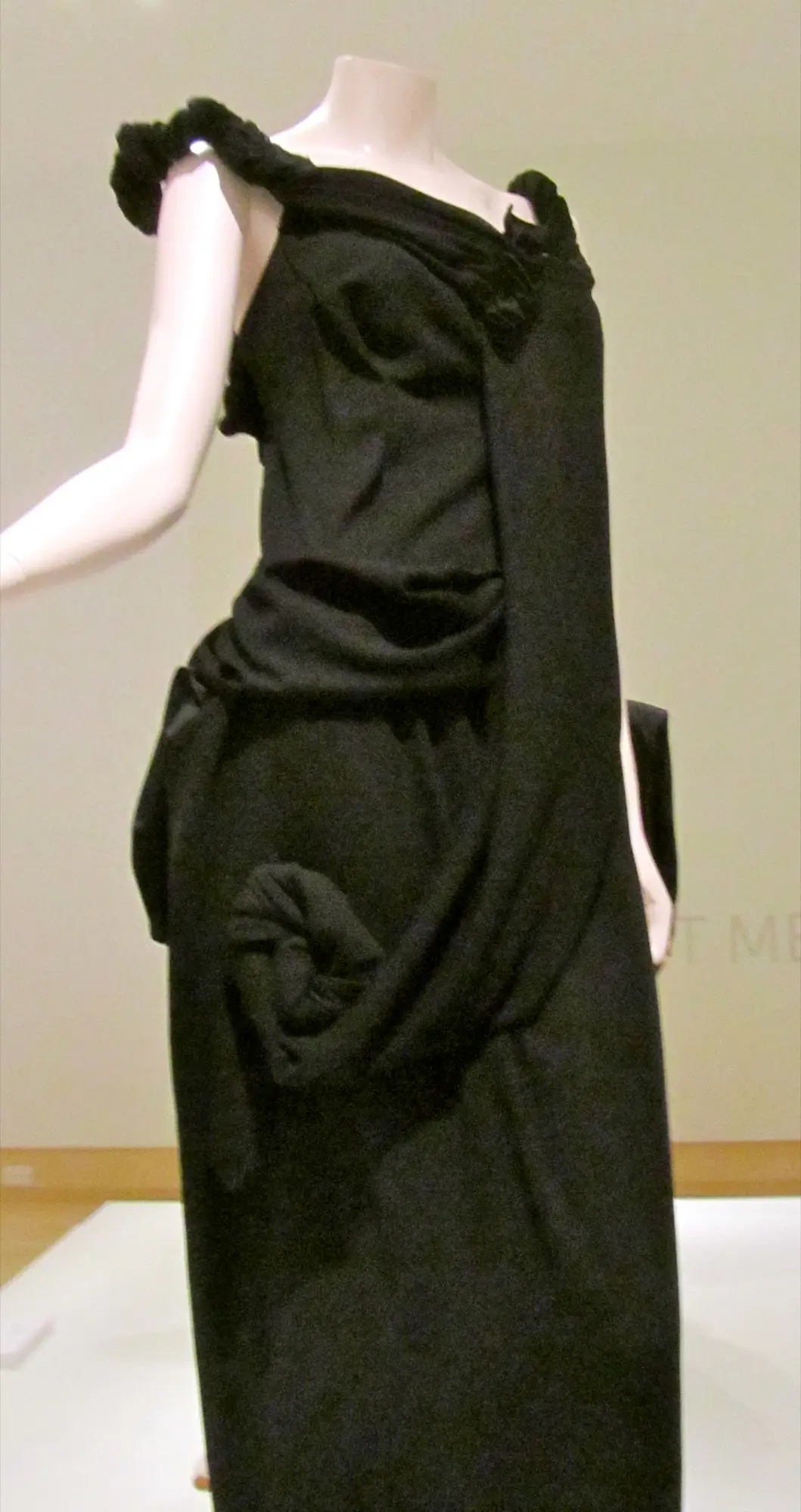
Two years after his small Paris debut — a modest affair held in a store on Rue du Cygne for a handful of guests in 1981 — Yohji Yamamoto’s Spring/Summer 1983 collection arrived as a fully realized vision that left no room for the kind of dismissals the press had attempted at his first showing. The clothes were overwhelming in their conviction. Oversized coats, asymmetric jackets, draped trousers — all in black, all refusing to conform to the body underneath. Models wore flat shoes where heels were expected. Their faces were unpainted where makeup was demanded. Their hair was unstyled, unshaped, allowed to exist as it was rather than as fashion required it to be. They moved through the space with a gravity that suggested they were not presenting clothes but inhabiting a philosophy, not walking a runway but performing a refusal.
The French fashion establishment had spent the intervening two years trying to decide what to make of the Japanese designers who had arrived on its doorstep, and the SS83 collection, shown alongside Rei Kawakubo’s equally confrontational Comme des Garcons presentation during October 1982 Paris Fashion Week, forced a reckoning. This was not a novelty act. It was not a one-season provocation. It was not going away. The French press responded with a hostility that revealed far more about its own limitations than about the clothes it was describing. Liberation, the French newspaper, dubbed the aesthetic “Hiroshima Chic” — a characterization that was racist in its casual conflation of Japanese identity with nuclear destruction and critically bankrupt in its failure to engage with what Yamamoto was actually proposing. Other writers described the clothes as rags that had survived an atomic explosion, a “poor look” that violated everything the fashion establishment held sacred. These descriptions were deeply disheartening to Yamamoto, who understood that his work was being read through a lens of cultural prejudice rather than aesthetic intelligence.
What Yamamoto was proposing was not poverty, not destruction, not nihilism, but an entirely different grammar of beauty. His black was not the black of Parisian chic — not the little black dress of Chanel, not the tuxedo of Saint Laurent. It was an absolute black, a black that functioned not as a color choice but as a philosophical position, a commitment to a single chromatic discipline that carried the weight of a vow. For Yamamoto, black was rebellion and modesty simultaneously, refusal and reverence in the same gesture — a color that absorbs everything and reveals nothing, that makes the wearer disappear into a silhouette while simultaneously making that silhouette inescapably present. The oversized silhouettes were not sloppy; they were generous, offering the wearer space and privacy within the garment, creating a zone between fabric and skin where the body could exist without being surveilled, without being measured against an external standard of attractiveness or propriety.
The distressed white cotton tunics with intentional holes — paired with white cotton trousers in deliberately ripped fabrics cut into ample, gathered forms — introduced a counterpoint to the dominant black, but the whites were no less radical. They were the whites of poverty, of worn cloth, of garments that had been used until they gave way, and their presence in a Paris fashion show was as confrontational as the blacks. The layering technique defied traditional Western tailoring, which operates through precision, through the exact correspondence of garment to body, through darts and seams that shape fabric into a second skin. Yamamoto’s layering was additive and approximate: garments placed over garments, volumes accumulated rather than sculpted, the final silhouette emerging not from a pattern but from a process of accumulation that echoed the Japanese concept of ma — negative space, the interval between things, the beauty of what is left undefined. The asymmetric hemlines were not imprecision but a considered rejection of Western tailoring’s insistence on bilateral symmetry, which Yamamoto understood as a form of control, a demand that the body present itself as balanced, orderly, resolved. His garments refused resolution. They hung at angles, trailed at one side, left the body’s geometry deliberately unsettled.
The collection crystallized what the Japanese avant-garde meant for Western fashion: not a regional style to be absorbed and diluted, not a trend to be cited for a season and then discarded, but a genuinely alternative system of values. Body and garment existed in a different relationship here. The Western tradition assumed that clothing should reveal the body, enhance it, bring it closer to an ideal form. Yamamoto proposed that clothing should protect the body, give it room, allow it to exist on its own terms rather than fashion’s. Beauty was located in different places — in the fall of fabric under its own weight, in the negative space between cloth and skin, in the dignity of being clothed rather than displayed, in the way a garment moves when the body moves and the way it maintains its own shape when the body is still. The huge brimmed hats hiding the models’ faces were the collection’s most visible gesture of refusal: a literal concealment of the one part of the body that fashion most insists on seeing, the face that sells the garment, that makes the model a personality rather than a form.
The Spring/Summer 1983 show did more than introduce an alternative aesthetic. Together with Kawakubo’s concurrent presentation, it proposed that the questions Western fashion had been asking about the body, about beauty, about the purpose of clothing itself, had been the wrong questions all along. The period from 1983 onward was subsequently characterized by the ascendancy of black and of deconstruction — the determination to dismantle Western fashion norms and examine what lay beneath them — and Yamamoto’s collection was one of the foundational acts of that demolition. It opened the door for the Belgian school, for Margiela’s conceptualism, for Helmut Lang’s industrial minimalism, for every designer who would subsequently understand that fashion’s purpose was not to decorate but to question. Yamamoto took the damage, bore the insults, watched his work reduced to a stereotype, and continued making what he had always made. The press eventually caught up. The clothes never needed to.