Greg Lauren
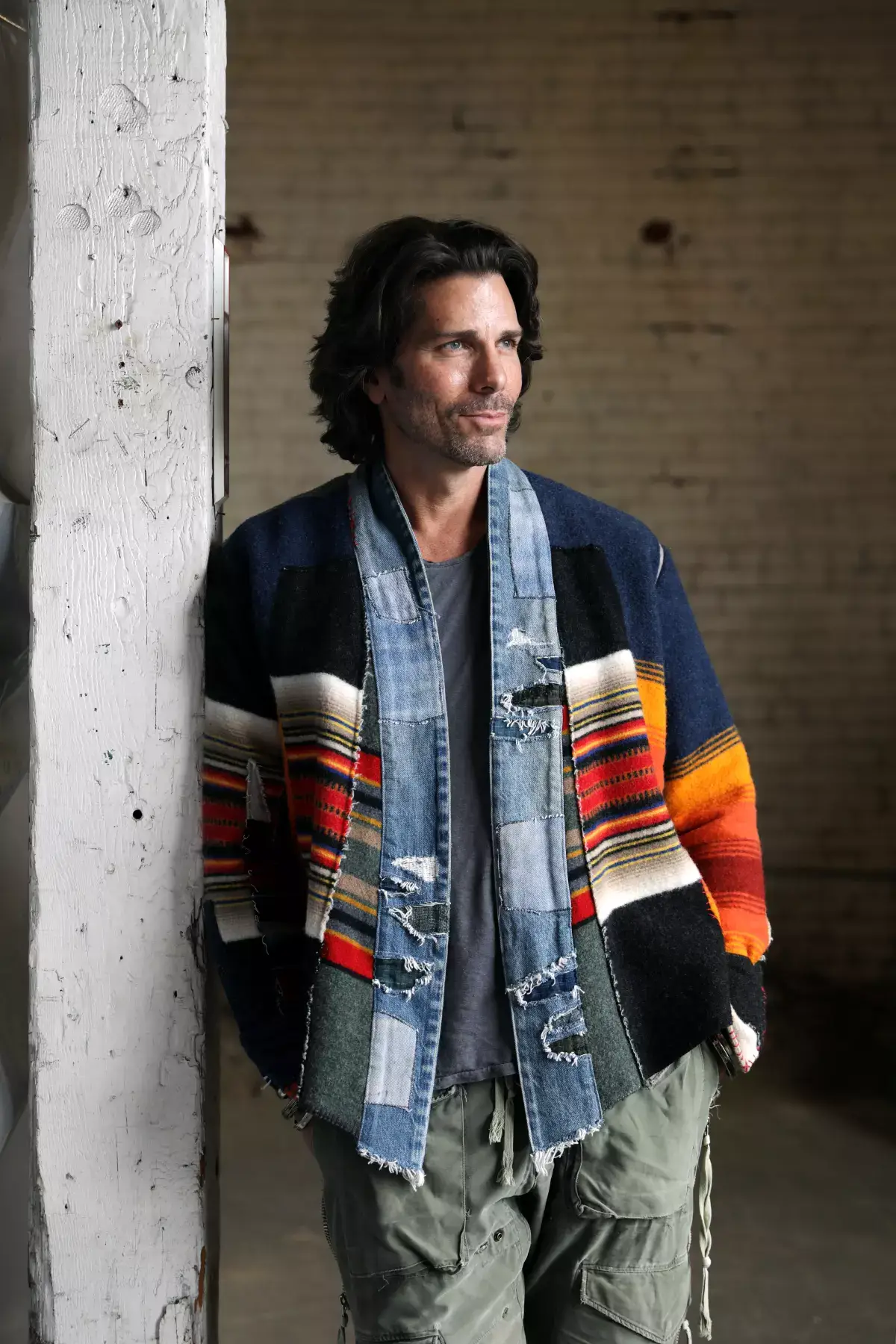
Greg Lauren was born on January 6, 1970, in New York City, into a family whose name is synonymous with a particular vision of American style — he is the nephew of Ralph Lauren, the son of Jerry Lauren, who served as head of men’s design at the Ralph Lauren Corporation for over forty years — and the weight of that inheritance is inseparable from the work he has produced, even though the work itself is an act of radical deconstruction that takes the Americana vocabulary his uncle codified and tears it apart at the seams. Lauren studied art history at Princeton, graduating in 1991, and spent the following two decades as a fine artist: painting nudes that sold for up to fifteen thousand dollars and were purchased by Renée Zellweger, Demi Moore, and Ben Stiller; creating a series of oil paintings called “Hero” that depicted superheroes in mundane domestic settings; and, most consequentially, producing “Alteration” — an exhibition of over forty life-size sculptures of iconic menswear garments hand-sewn from Japanese paper to replicate wool, cotton, and gabardine, each one deliberately frayed and wrinkled to suggest a history the garment had never actually lived. The paper garments were a rehearsal for everything that followed.
In February 2011, Lauren launched his eponymous fashion label at Barneys New York with a collection of deconstructed suits, field jackets, and tuxedos made from repurposed fabrics — military duffel bags, cashmere blankets, army surplus, vintage flannel — each piece assembled by hand in his Los Angeles studio with the patchwork logic of a quilter and the eye of a painter who treats a seam as a brushstroke. The signature piece was and remains the tent jacket, constructed from actual U.S. Army tents, a garment that literalizes the relationship between clothing and shelter in a way that recalls Kosuke Tsumura’s Final Home while operating at a price point — jackets retail from nineteen hundred to over four thousand dollars — that situates the proposition firmly within luxury rather than conceptual art.
The production is almost entirely handmade. Lauren touches everything, occasionally going so far as to tear apart a near-complete piece to throw a patch over a rust stain or fill a gap that his eye identifies as compositionally incomplete. The garments are pieced together by Los Angeles-based quilters using post-consumer scraps and vintage materials, and the one-of-a-kind character of each piece is not a marketing conceit but a manufacturing reality — the variation in source materials means that no two jackets, no two shirts, no two patchwork trousers can be identical. This approach — zero-waste construction from reclaimed textiles, hand-distressing, artisanal assembly — aligns Lauren with the Japanese designers who have spent decades elevating reconstruction into a design philosophy. The comparison to Kapital’s boro-inspired denim, to Visvim’s hand-dyed indigo, to Junya Watanabe’s patchwork reconfigurations of American workwear is inevitable and earned: Lauren occupies the same conceptual territory, arrived at from the opposite direction, an American deconstructing the mythology that the Japanese designers have spent years reconstructing with reverence.
The relationship to Ralph Lauren is the question that every profile asks and that the work both answers and refuses to answer. The shared vocabulary is obvious — military surplus, Western wear, the worn-in textures of American heritage clothing — but where Ralph Lauren presents Americana as aspiration, as a vision of the good life rendered in cashmere and cavalry twill, Greg Lauren presents Americana as aftermath, as what remains after the vision has been disassembled and stitched back together with whatever materials survived. The distinction is not oppositional but generational: the uncle built the dream, the nephew lives in its ruins and finds beauty there.
Distribution has been concentrated in the institutions that recognize the territory between art and fashion: Barneys New York, Dover Street Market in London, New York, Tokyo, and Ginza — where Rei Kawakubo hosted an original Lauren installation — Bergdorf Goodman, Maxfield in Los Angeles, Isetan in Tokyo, Kith, 10 Corso Como Seoul, and L’Eclaireur in Paris. The brand is available in approximately forty stores worldwide, and the price positioning — ultra-luxury, justified by the labor hours visible in every seam — ensures that the audience remains small enough to sustain the artisanal model that makes the clothes possible. What Greg Lauren proved, beginning with paper sculptures in a Santa Monica gallery and continuing through a decade of hand-stitched tent jackets, is that destruction can be a form of design, that a garment’s history does not have to be real to be felt, and that the most interesting thing you can do with the American heritage vocabulary is take it apart and see what holds.