Helmut Lang
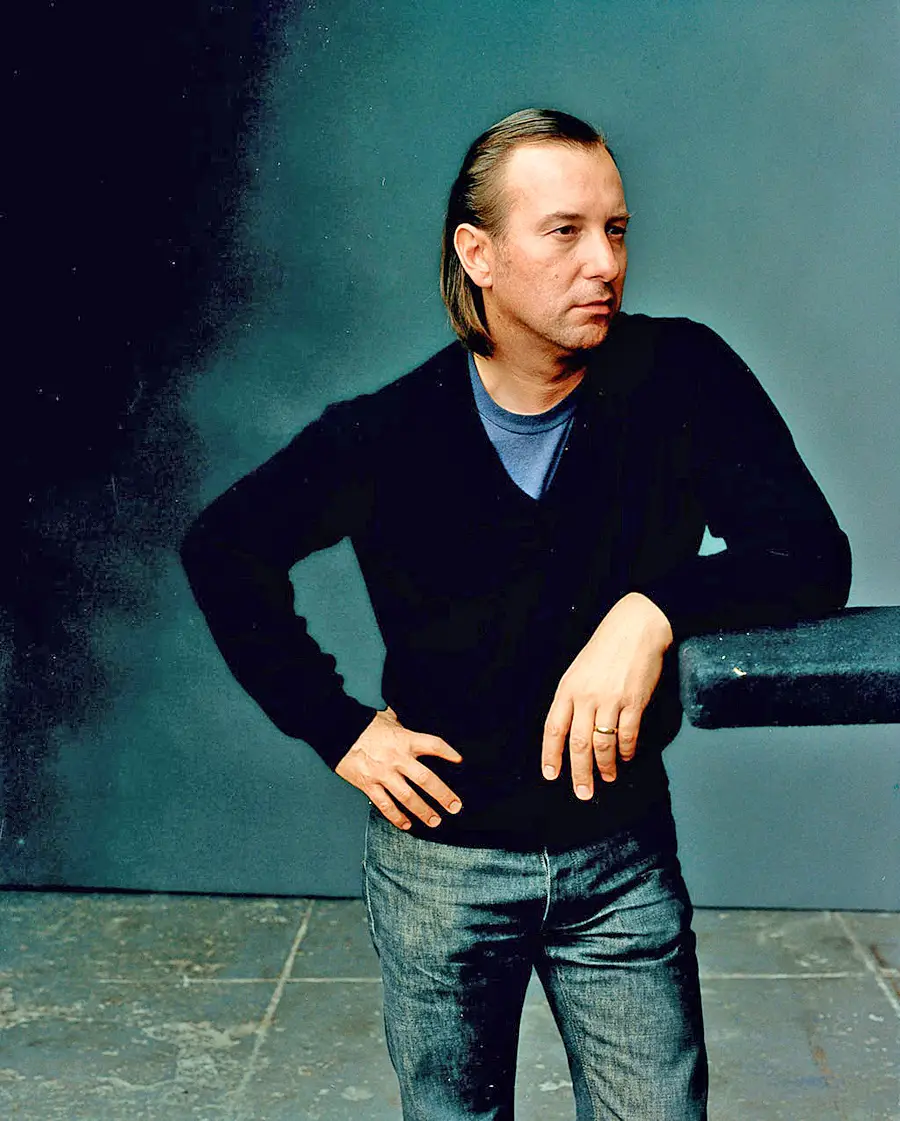
Helmut Lang had no formal fashion training. He grew up in an Alpine village near Salzburg, raised by his grandparents in circumstances far removed from the Parisian ateliers and Milanese workshops that shaped most designers of his generation. He opened a made-to-measure studio in Vienna in 1977, pivoting from business studies into a discipline he would learn entirely through practice, and by 1986, when he showed his first runway collection at the Centre Georges Pompidou in Paris, he had already developed the vocabulary that would define the next two decades of fashion: clean, confrontational, stripped of every ornament that did not earn its place. Lang understood that minimalism was not about absence but about pressure — what remains when everything unnecessary has been removed must be precisely, almost unbearably right. His tailoring had the lean exactitude of architecture. His fabrics — rubber, neoprene, reflective tape, bonded synthetics — came from industry, not from the traditional textile houses, and they gave his clothes a tactile strangeness that separated them from the polished minimalism of his contemporaries.
What distinguished Lang from the other minimalists of the 1990s — the clean lines of Calvin Klein, the studied restraint of Jil Sander — was the tension he introduced into austerity itself. There was nothing serene about a Lang garment. A shirt might be cut with the precision of a surgical instrument, but the fabric would carry the cold sheen of something manufactured for protection rather than beauty. Rubber panels appeared alongside wool. Reflective tape, the kind used on highway workers’ vests, became a design element of extraordinary elegance when applied with Lang’s economy of gesture. He debuted his men’s collection in 1987, and the menswear quickly became the sharper expression of his vision — leaner, more explicitly industrial, free from the lingering expectations of femininity that even his most radical womenswear had to negotiate. The silhouettes anticipated what the next generation would call normcore by nearly two decades: narrow trousers, simple knits, utilitarian jackets that derived their beauty from proportion and material rather than embellishment.
In 1997, Lang made the decisive move of relocating his headquarters from Vienna to New York City, a city whose raw pragmatism matched his sensibility more honestly than Paris ever had. The following year he delivered what remains his most concentrated body of work. The Fall/Winter 1998 collection worked as both fashion and proposition. Every piece functioned doubly: the Painter Jeans, splattered with what appeared to be studio accidents but was in fact a controlled application of paint, collapsed the distance between art-making and garment-making. The utilitarian strapping referenced protective gear without becoming costume. The palette was restricted to black, white, and the occasional shock of industrial orange — the color of construction sites, of caution, of things that exist to be noticed under harsh light. That same year, Lang became the first major designer to present a collection online, streaming eighty-one looks in what he described as a desire to include the end consumer in a more direct manner. He was also among the first to advertise on the internet, gestures that read as visionary now but at the time simply reflected his disinterest in doing things the way they had always been done. He pushed his spring presentation six weeks ahead of the European schedule, forcing New York Fashion Week into a new temporal relationship with Paris — a structural disruption as significant as any aesthetic one.
In 2000, Lang was nominated for all three major CFDA awards — Womenswear, Menswear, and Accessory Designer of the Year — simultaneously, a distinction no designer had achieved before. He famously declined to accept them in person, a refusal that surprised no one who understood his temperament. The previous year, he had sold a fifty-one percent stake in his company to the Prada Group, a transaction that gave him financial stability and distribution power but introduced the corporate pressures that would ultimately accelerate his departure. Lang retained control over design and advertising, and for several years the arrangement held, but the logic of conglomerate fashion — the demand for growth, for expansion into categories that did not interest him, for the transformation of a vision into a brand — was fundamentally incompatible with his approach. He was a designer who wanted to make fewer, better things. The industry wanted more.
He sold the remainder of his stake and left fashion entirely in 2005. The departure was absolute, the finality of it almost unprecedented in an industry that thrives on comebacks and reinventions. He moved to a property in East Hampton, Long Island, and began producing large-scale sculptural work, much of it involving the deliberate destruction of his own fashion archive — garments shredded, burned, encased in resin, their identities dissolved into new forms. The gesture was not nostalgic but aggressive, a refusal to let the past become a museum piece. Lang has never shown interest in returning, and the fashion world has never stopped wanting him to. The brand continued under various creative directors, but without Lang’s hand it became what he had always resisted: a name without a nervous system.
His influence remains one of the clearest through-lines in contemporary fashion. Rick Owens’s monochrome severity, Raf Simons’s conceptual menswear, the entire normcore sensibility of the 2010s, the industrial minimalism that became the default mode of a certain kind of cool — all of it runs back to that studio in Vienna, to a designer who believed that fashion’s purpose was not to decorate the body but to sharpen it against the world. Lang proved that restraint could be more provocative than spectacle, that a rubber-bonded seam could carry more intellectual weight than the most elaborate couture embroidery. That he chose to leave at the height of his powers, rather than watch the slow dilution that claims most designers, is perhaps the most Helmut Lang gesture of all — the final, decisive subtraction.