Avant-Garde Menswear
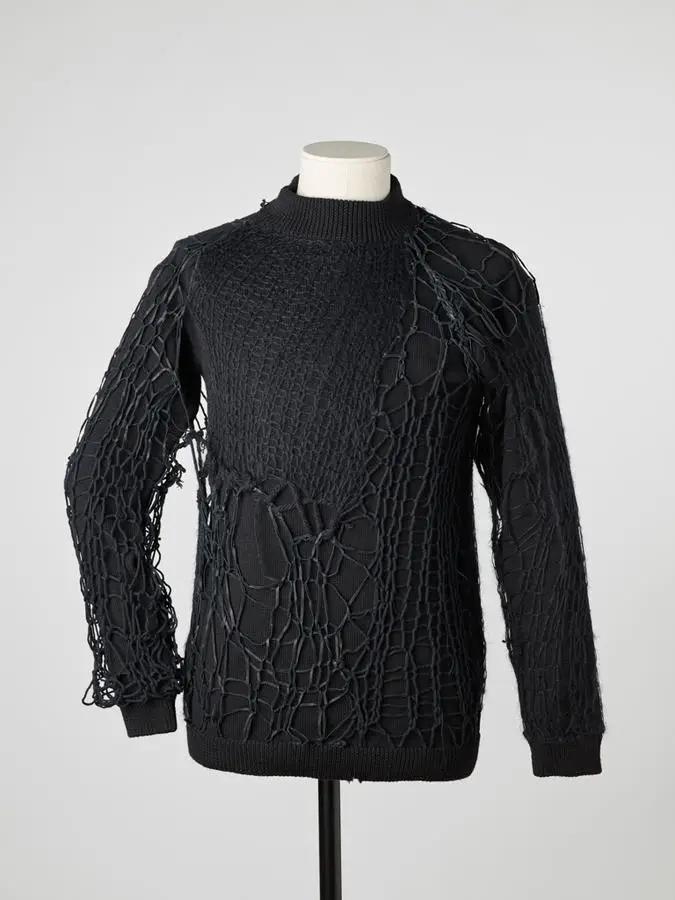
For most of the twentieth century, men’s fashion operated within narrow parameters. The suit, the casual trouser, the sportswear silhouette — these were the permitted forms, and deviation was understood as eccentricity rather than design. The muscular, broad-shouldered silhouette of power dressing dominated the 1980s; the preppy vocabulary of khakis and blazers defined the American mainstream. A man who cared about what he wore was, in the cultural imagination, either a dandy or a narcissist, and neither designation was intended as a compliment. Avant-garde menswear dismantled this assumption. Beginning in the early 1990s, a generation of designers — led by Helmut Lang in Vienna and New York, Raf Simons in Antwerp, and Rick Owens in Los Angeles — demonstrated that men’s clothing could be as conceptually rigorous, as culturally engaged, and as aesthetically radical as anything happening in womenswear. The shift was not about making men’s fashion more feminine. It was about making it more serious.
The groundwork had been laid in the preceding decade. Rei Kawakubo’s Comme des Garcons Homme Plus, launched in 1978, had been challenging conventional masculine dress since before the movement had a name, treating the male body with the same conceptual rigor she applied to her womenswear. Yohji Yamamoto’s oversized, deconstructed, primarily black menswear proposed an intellectual approach to masculinity that rejected the body-conscious assertiveness of Western tailoring. The Antwerp Six — the group of Royal Academy of Fine Arts graduates who presented their work in London in 1986 — introduced a Belgian sensibility that was darker, stranger, and more philosophically grounded than anything the mainstream menswear industry was producing. Ann Demeulemeester’s romantic, poetic dark menswear — military boots, oversized coats, asymmetric construction — demonstrated that men’s clothing could operate in the register of feeling rather than function. But it was the convergence of Lang, Simons, and Owens in the 1990s that transformed these individual projects into a recognizable movement.
Helmut Lang’s men’s collections established the foundation. His approach merged minimalism with military and industrial references: bullet-proof vest silhouettes, straps and harnesses inspired by parachutes and bondage gear, materials borrowed from the factory and the highway. When he launched Helmut Lang Jeans in 1996, he gave denim luxury status not through embellishment but through the same reductive intelligence that governed his tailored work — the Painter Jeans of 1998, with their controlled splatter, demonstrated that even the most casual garment could carry conceptual weight. Lang proved that a man’s wardrobe could be stripped to its essentials without becoming boring, that reduction was itself a creative act requiring more skill and conviction than addition.
Raf Simons arrived from a different direction entirely. His background in industrial and furniture design gave him a structural approach to garments, but it was his immersion in Belgian youth culture — the post-punk and New Wave nights, the gabber raves, the mosh pits of Antwerp clubs — that gave the work its emotional urgency. His first menswear collection in 1995, produced with no formal fashion education, channeled the aesthetic of American college students and English schoolboys filtered through subcultural attitude. The Fall/Winter 2001 “Riot Riot Riot” collection and the Spring/Summer 2002 collaboration with Peter Saville were fashion-as-dispatch-from-the-front-lines, collections that treated the runway as a site of cultural commentary with a precision that journalism and documentary could not match. The iconic MA-1 Camo Patched Bomber from “Riot Riot Riot” and the New Order Bomber from the Saville collaboration became the paradigmatic “grail pieces” of the archive market, garments whose cultural significance gave them the status of art objects. Simons gave an entire generation of young men permission to care about what they wore without sacrificing their subcultural credentials. He introduced a slimmer silhouette on a more attenuated body with dropped shoulders, a proportion that would become the default for a decade of menswear that followed.
Rick Owens completed the triangle by building a total aesthetic world — one in which the male body became a site for architectural experimentation, draped and extended and distorted into silhouettes that had no precedent in conventional menswear. Founded in Los Angeles in 1994 and later relocated to Paris, the label proposed a black-on-black goth-grunge aesthetic with impeccable cuts and monumental proportions: dropped crotches, extended torsos, platform soles that made the body taller and stranger. The Geobasket sneaker, debuting in the Fall/Winter 2006 “Dustulator” collection, became a tribal marker — an object that signaled membership in a community of people who understood that a sneaker could be as meaningful as a Savile Row suit. The monochrome palette became a uniform for those who had decided that the conventional vocabulary of men’s dressing — the navy blazer, the grey flannel, the white shirt — was not merely insufficient but complicit in a vision of masculinity they wished to reject.
The movement’s dissemination was accelerated by internet culture in ways that no previous fashion movement had experienced. Online forums — StyleZeitgeist, Styleforum, SuperFuture — became the seminar rooms where a new generation debated the merits of Rick Owens versus Helmut Lang, analyzed construction details from photographs, and developed a critical vocabulary for menswear that the fashion press had never bothered to provide. The “goth ninja” aesthetic of the early 2010s Tumblr era popularized the movement’s visual language among young men who might never set foot in a Dover Street Market. Grailed and other resale platforms made vintage pieces accessible beyond the rarefied world of fashion insiders, and the archive collecting culture that emerged drove prices for key Raf Simons pieces into five-figure territory. The V&A’s 2022 exhibition “Fashioning Masculinities: The Art of Menswear” — the museum’s first major exhibition dedicated to men’s clothing — confirmed that what had begun as a marginal practice had become a field with its own history, its own canon, and its own institutions.
The movement’s legacy extends beyond any individual designer or garment. Thom Browne’s shrunken suits subverted the most conservative of menswear forms from within. Craig Green’s sculptural, art-influenced designs pushed the boundary between garment and installation. The Taschen monographs published on Simons and Owens in 2014 treated their work with the critical seriousness previously reserved for architects and fine artists. Together, these designers — working independently, from different cities, with different obsessions — created the conditions for men’s fashion as we now understand it: a field where conceptual ambition is not the exception but the expectation, where the male body is understood not as a fixed form to be clothed but as a variable to be explored, and where the question of what it means to get dressed in the morning has become as philosophically loaded as any other question about how we choose to present ourselves to the world.