Raf Simons
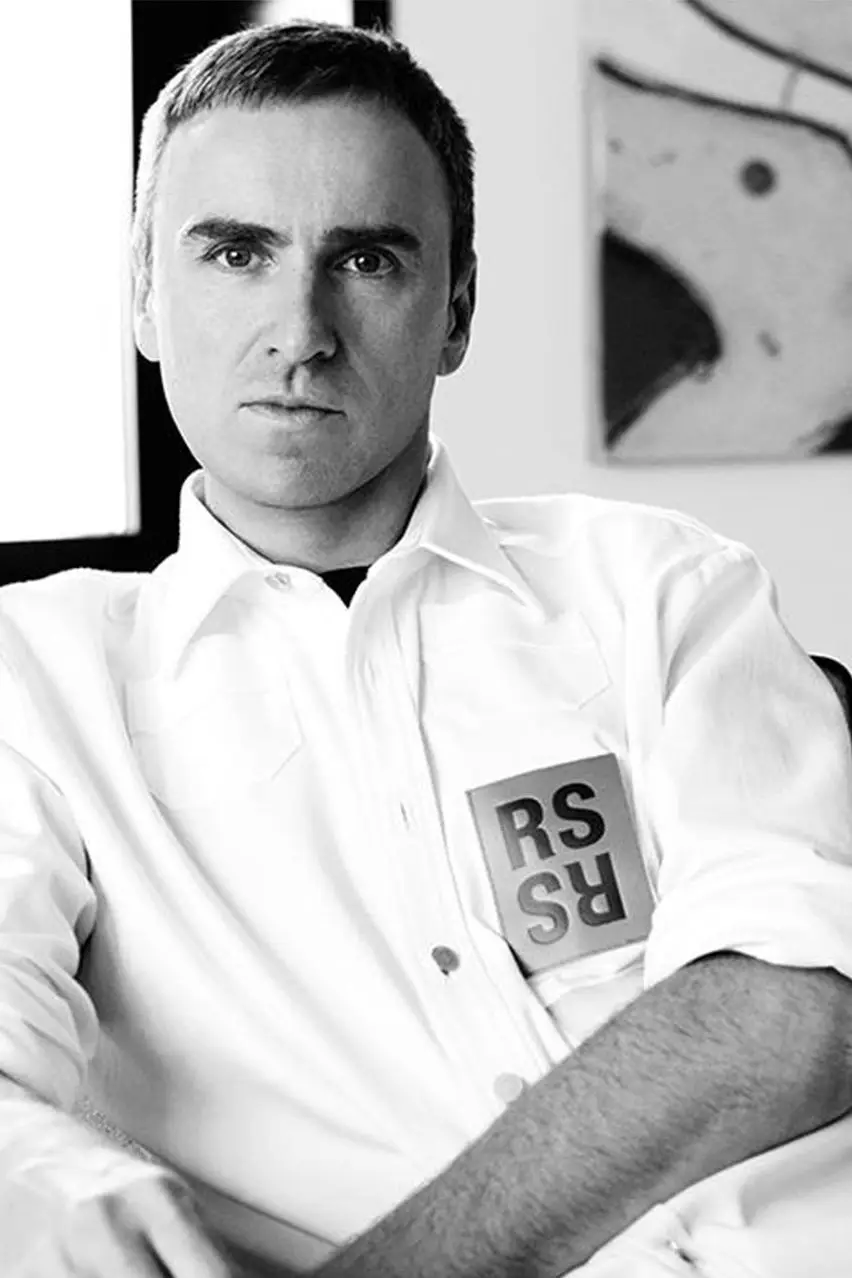
Raf Simons studied industrial and furniture design at the LUCA School of Arts in Genk, graduating in 1991, and for a brief period it seemed he would spend his career designing objects rather than garments. An internship at the studio of Walter Van Beirendonck, one of the Antwerp Six, introduced him to the possibility that fashion could function as a conceptual practice with the same intellectual seriousness as architecture or product design. Martin Margiela’s work confirmed it. Linda Loppa, then head of fashion at Antwerp’s Royal Academy of Fine Arts, encouraged the transition. Simons launched his menswear label in 1995 with no formal fashion education, and the early collections — raw, confrontational, saturated with the energy of Belgian youth culture and post-punk music — arrived like a dispatch from a world the fashion establishment didn’t know existed. He was not designing for the industry. He was designing for the boys he saw at Warp Records nights and in the mosh pits of Antwerp clubs, and the specificity of that audience gave the work an authenticity that fashion’s establishment could sense but couldn’t replicate.
His first Paris runway show in 1997 codified the aesthetic: a hybrid of American college culture and English schoolboy formality, filtered through the attitude of New Wave and punk. The silhouettes were deliberately destabilizing — oversized tops swallowing narrow frames, slim trousers creating a vertical tension that made the body look both vulnerable and defiant. Simons was reading youth subculture not as a sociologist but as a participant, and the collections functioned as emotional documents of a specific demographic’s experience: the anxiety of young men in late capitalism, the desire to disappear inside one’s own clothing, the way music and fashion become inseparable when you are seventeen and everything feels urgent. By 2000, the intensity had become unsustainable. He closed the company, took a sabbatical, and accepted a position as head of the fashion department at Vienna’s University of Applied Arts, a role he would hold until 2005. The pause was strategic, not defeated.
The Fall/Winter 2001 “Riot Riot Riot” collection and the Spring/Summer 2002 “Woe Unto Those Who Spit on the Fear Generation… The Wind Will Blow It Back” are the twin peaks of his early career, and together they constitute perhaps the most important consecutive seasons in the history of menswear. “Riot Riot Riot” was shown in Paris in October 2001, one month after September 11th. The timing was coincidental — Simons had been developing the collection for months — but the resonance was inescapable. The clothes vibrated with a collective anxiety that had suddenly become everyone’s, not just the disaffected Belgian teenagers who had always been his primary constituency. Oversized hoodies swallowed the models’ frames. Military-inspired parkas were layered over slim trousers. The proportions were deliberately wrong — tops too large, pants too tight — creating silhouettes that suggested bodies trying to disappear inside their own clothing. He cast young, non-professional models pulled from the streets and clubs of Antwerp and Brussels, and their visible discomfort in front of the audience became part of the collection’s emotional texture.
The following season was staged in London and sharpened the provocation. The collaboration with Peter Saville — New Order and Joy Division graphics screen-printed onto bombers and parkas — fused music, graphic design, and fashion into something that transcended all three categories. The bomber jacket bearing Saville’s artwork would eventually command five-figure prices on the secondary market and effectively invented the concept of the “archive piece” as cultural currency. But the significance of these collections extends beyond any individual garment. They were the moment at which Simons proved that menswear could function as cultural seismography — that a collection of clothes could register the emotional temperature of a historical moment with a precision and immediacy that other cultural forms struggled to achieve.
Simons’s subsequent career has demonstrated that his sensibility scales without losing its edge. Seven years at Jil Sander, from 2005 to 2012, produced womenswear and menswear of rare precision, proving that his raw energy could coexist with the most exacting standards of European luxury. The move to Christian Dior in 2012 was his most audacious appointment: the most conceptual menswear designer of his generation taking control of the most traditional couture house in Paris. The Dior collections — particularly the couture — proved he could handle Bar jackets and tulle without capitulating to the house’s conservatism. His tenure at Calvin Klein as chief creative officer, from 2016 to 2018, attempted to redefine American fashion through the lens of his particular obsessions — horror films, Americana, Sterling Ruby’s art — and earned him consecutive CFDA Womenswear Designer of the Year awards in 2017 and 2018, making him the second person in history to win both the Womenswear and Menswear prizes. The appointment failed commercially but produced collections of genuine ambition.
Since April 2020, Simons has served as co-creative director of Prada alongside Miuccia Prada, a collaboration between two designers whose intellectual approaches to fashion are different enough to generate productive friction. He closed his eponymous label in 2022 after the Spring/Summer 2023 collection shown in London, a decision that felt less like an ending than a consolidation. But it is the early menswear that endures as his most vital contribution: the proof that men’s fashion could be as conceptually ambitious, as emotionally raw, and as culturally engaged as any other form of creative expression. Helmut Lang showed that men’s minimalism could be radical. Simons showed that men’s maximalism could be, too.