Rick Owens
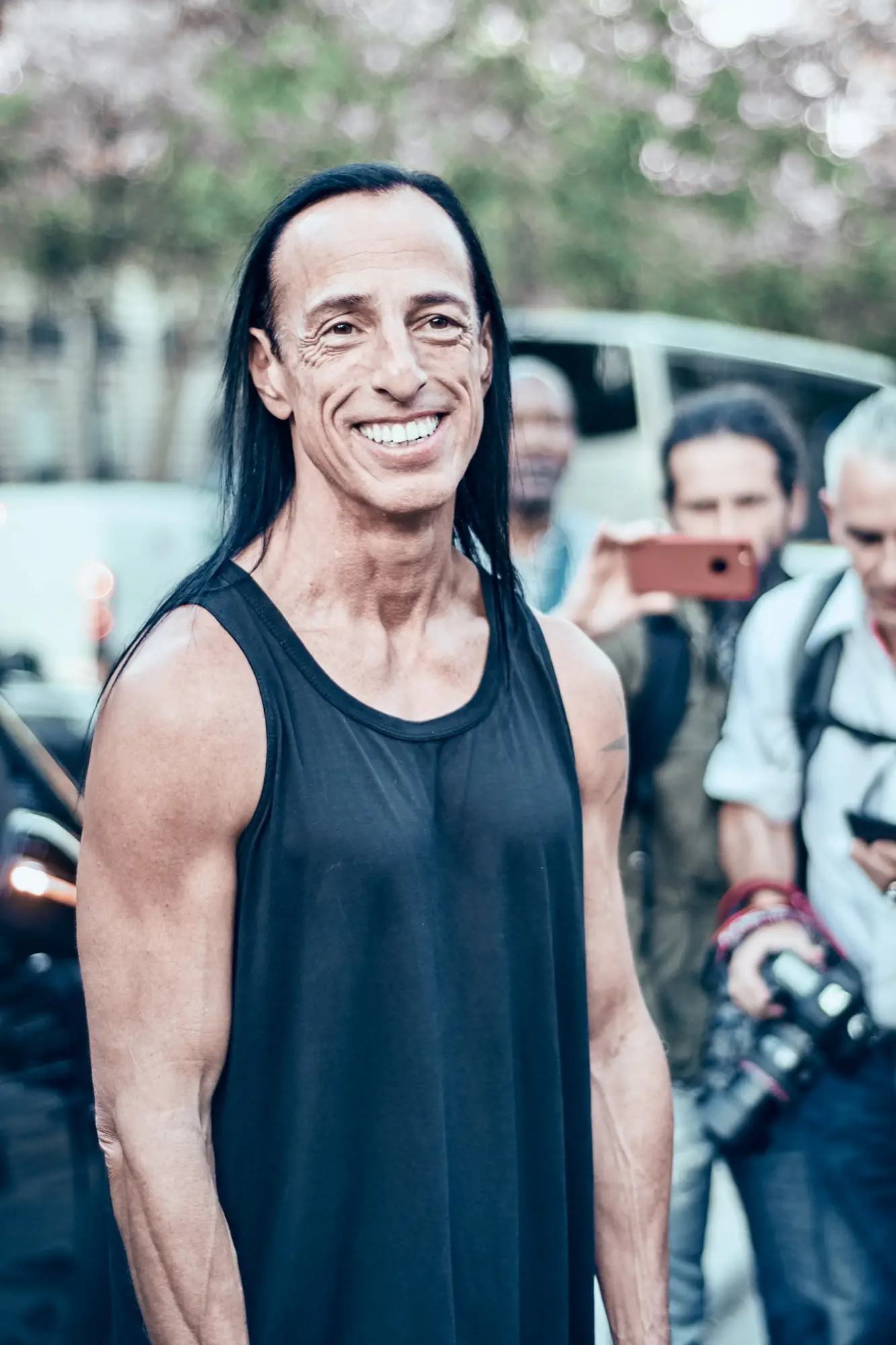
Rick Owens was born Richard Saturnino Owens in Porterville, California, in 1961, raised in a conservative Catholic household by John and Concepcion Owens, his mother’s Mexican heritage providing a thread of cultural otherness that would later surface in his work’s persistent engagement with the body as a site of beauty and strangeness. He moved to Los Angeles in the late 1970s, studied for two years at Otis College of Art and Design, then enrolled in pattern-making and draping courses at Los Angeles Trade-Technical College — a vocational program that taught him the mechanics of garment construction with a directness that art school could not provide. For most of the late 1980s and early 1990s, he worked in LA’s garment district knocking off designer clothing for small manufacturers, learning the architecture of other people’s ideas from the inside out. It was a disreputable apprenticeship, and Owens has spoken about it with the candor that characterizes everything he does: he learned to cut patterns by copying, and the knowledge of construction he gained in those years became the foundation of everything that followed.
He launched his own line in 1994, operating out of a store on Hollywood Boulevard, producing garments in his apartment with the kind of resourcefulness that characterized LA’s independent fashion scene. The early collections were sold to a handful of stores and worn by the kind of people who sought out the margins — musicians, artists, the nocturnal population of a city that the fashion establishment still considered a cultural afterthought. It was during this period that he met Michele Lamy, who owned the sportswear brand Lamy and who would become his life partner, business collaborator, and the co-architect of an empire built on shared obsession. By the late 1990s, the work had begun to attract attention outside Los Angeles: Kate Moss was photographed by Corinne Day for Vogue Paris wearing one of his leather jackets, an image that introduced Owens to an audience that had never heard his name but immediately understood his language.
In 2001, Anna Wintour’s attention arrived through Andre Leon Talley, and with Vogue America’s sponsorship, Owens showed his first proper runway collection, “Sparrows,” for Fall/Winter 2002 in New York. The aesthetic had already crystallized: elongated silhouettes, heavy drapery, a palette that treated black not as a single color but as a spectrum ranging from asphalt to oil to charcoal to void. He won the CFDA Perry Ellis Award for Emerging Talent in 2002, a prize that signaled the industry’s recognition of a designer who had already been working for nearly a decade. The following year, he and Lamy moved to Paris, establishing their atelier in a historic five-story building that had once served as the offices of President Mitterrand — a workspace whose monumental proportions matched the scale of Owens’s ambitions. In 2004, they formalized their business partnership as Owenscorp.
His work draws from Helmut Lang’s industrial austerity but pushes it toward something more visceral and theatrical. Where Lang subtracted, Owens distorts. The proportions are exaggerated — dropped crotches that shift the body’s center of gravity, extended torsos that make the wearer appear stretched by some invisible force, platform soles that add inches to the body’s height and strangeness. The materials — leather, jersey, cotton, waxed fabrics — are chosen for their capacity to drape and to age, to acquire the patina of a life lived in them. The Geobasket sneaker, introduced in 2007, became a totem for an entire subculture that didn’t exist before Owens created it: a high-top sneaker that was simultaneously athletic and gothic, its exaggerated tongue and thick sole transforming the foot into something monumental. The adidas collaborations that followed — the Runner, the Springblade, the ongoing dialogue between sportswear engineering and Owens’s dark formalism — demonstrated that his vision could absorb commercial partnership without dilution.
The runway presentations have become progressively more ambitious, more explicitly performative, more willing to risk absurdity in pursuit of emotional truth. The Spring/Summer 2016 “Cyclops” women’s show, staged at Paris Fashion Week, sent models down the runway carrying other models strapped to their bodies like human backpacks — a spectacle that collapsed the boundary between fashion show and performance art. It was absurd and moving and deeply strange, and nobody else could have done it. The Cooper-Hewitt Design Award in 2007, the CFDA Lifetime Achievement Award in 2017, and the CFDA Menswear Designer of the Year in 2019 marked institutional recognition of a career that had always operated at a deliberate angle to institutional approval. The Fashion Group International Rule Breaker Award, also in 2007, was perhaps the most aptly named.
What makes Owens singular is not the darkness — darkness is easy — but the discipline. Every collection functions within the same vocabulary, yet each season finds new inflections, new tensions between the architectural and the organic, the monumental and the intimate. The brutalist concrete of his Paris store on Place du Palais Royal, the stepped furniture he designs and shows at the Salon del Mobile, the collaborations with Carpenters Workshop Gallery, the physicality of his runway presentations: all of it is the same project, expressed through different materials. He has built, with Lamy, a world that operates with the internal logic of a complete cosmology — clothing, furniture, architecture, performance, all governed by the same proportional relationships, the same commitment to materials that carry weight both literal and metaphorical. He has said that glamour is a form of armor. His clothes function accordingly — protective, monumental, strange, and oddly tender beneath the severity, garments for people who have decided that the body is both a fortress and a temple and that the distinction between the two is less important than the devotion required to inhabit either.