Geobasket
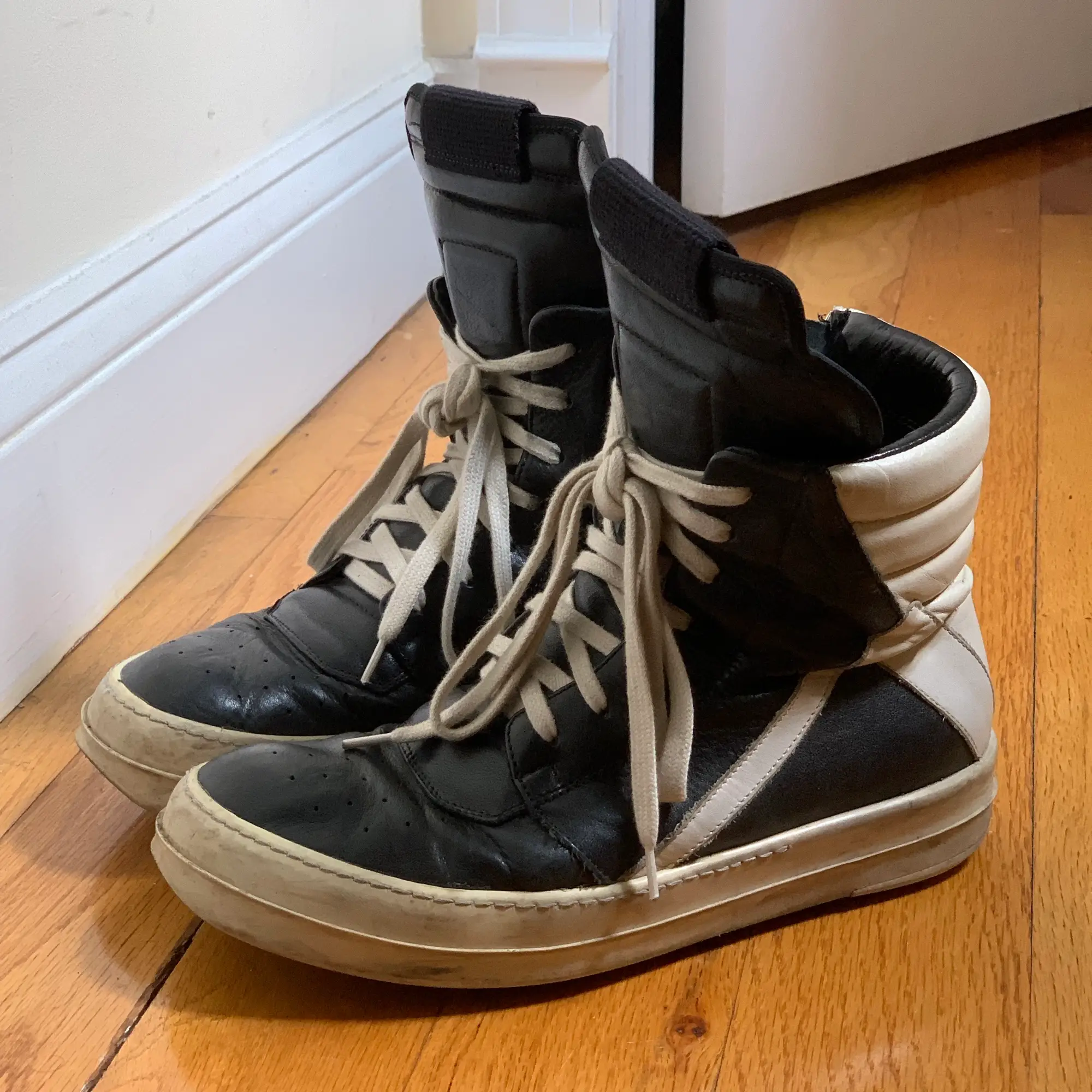
A high-top sneaker that became the uniform of a subculture.
The Geobasket arrived without ceremony — added to Rick Owens’s footwear line around the Fall/Winter 2006 “Dustulator” collection under the original name “Dunk” — and within a few seasons it had become one of the most significant sneakers in fashion. The design is aggressive and unmistakable: a high-top silhouette with exaggerated proportions, a chunky sole that adds visible height, and a paneled leather upper that references vintage basketball shoes while distorting their proportions beyond recognition. The tongue is oversized. The lacing is elongated. A chunky side-zip runs along the ankle. Everything about it is louder and stranger than the sneaker it references, which is precisely the point. Owens described his intention as building something like monster trucks for feet — a phrase that captures both the sneaker’s physical scale and its creator’s cheerful refusal to be tasteful about it.
The name itself carries a history that illuminates the sneaker’s complicated relationship with the industry it disrupted. The original “Dunk” designation, combined with a Swoosh-like check detail on the medial side, drew what was reportedly a cease-and-desist letter from Nike — though neither party has publicly confirmed the correspondence. What is known is that the check disappeared, the name changed to Geobasket — a portmanteau of geode, the oddly shaped rock formation, and basket, a nod to the basketball sneaker form — and the shoe continued its ascent unimpeded. The episode is instructive. Owens had drawn explicitly from Nike, Adidas, and Puma in designing the shoe, synthesizing elements from all three into something that belonged to none of them. The design was an act of appropriation so thorough that it constituted originality, a paradox the legal system was not equipped to resolve. Nearly two decades later, in 2024, Nike and Owens would collaborate officially on a shoe called, with considerable irony, the Rick Owens x Nike Dunk — the industry’s belated acknowledgment that Owens had been right about what a sneaker could be.
The construction reflects Owens’s insistence that luxury and brutality are not opposed categories. The Geobasket is made in Italy from premium leather — pigskin and cowhide variants depending on the season — with the care and finish of a handmade dress shoe. The stapled sole, the metal hardware, the precision of the stitching all belong to the tradition of Italian artisanal footwear. But the silhouette belongs to the basketball court and the skate park, to the world of athletic shoes that Owens found too prosaic and decided to rebuild at a scale and intensity that the sneaker industry had never attempted. This collapse of high and low — executed without irony, without the winking self-awareness that characterized so much high-low fashion of the period — was new. The Geobasket didn’t reference street culture from above. It entered it, and street culture, recognizing something genuine, made room. Current retail prices hover between one thousand and fourteen hundred dollars, a figure that would have been unthinkable for a sneaker before Owens demonstrated that the category could sustain it.
What the Geobasket achieved was the creation of a tribal marker. Owens had always attracted a devoted following — people who wore head-to-toe Rick and recognized each other on the street — but the Geobasket gave that tribe a totem. It was the single piece that signaled membership most immediately: visible from a distance, impossible to mistake for anything else, too aggressively proportioned to be worn casually or by accident. Internet forums dedicated to Owens’s work and to the broader dark fashion aesthetic — StyleZeitgeist, SuperFuture, the Tumblr networks that coalesced around terms like goth ninja and health goth in the early 2010s — treated the Geobasket as a gateway piece, the first Rick Owens item many people purchased and the one that committed them to the aesthetic. A$AP Rocky, who rapped that Rick Owens was usually what he was dressed in, and Jack Dorsey, the tech executive whose uniform of black Owens pieces became its own kind of Silicon Valley statement, represented opposite ends of the Geobasket’s demographic reach, united only by the sneaker’s capacity to signify a particular relationship to fashion: serious, committed, unconcerned with mainstream approval.
The Geobasket also represented a structural innovation within the market itself. Where Helmut Lang had incorporated industrial materials into luxury fashion, Owens was incorporating luxury craftsmanship into a streetwear form, and in doing so he created the template for the luxury sneaker market that Balenciaga, Givenchy, and countless others would later exploit. The Geobasket has been in continuous production for nearly twenty years, making it one of the longest-running luxury sneaker lines in existence, and its influence on the broader market — on the idea that a sneaker could cost a thousand dollars and justify that price through material, construction, and design rather than through hype alone — is difficult to overstate. Owens gave fashion permission to take sneakers seriously, not as a novelty or a commercial concession but as a form capable of the same ambition and intensity as any other garment. The Geobasket was the proof, and it remains, all these years later, the most convincing argument he ever put on someone’s feet.