Armadillo Boot
A 12-inch hand-carved boot from McQueen's final collection — fashion's most extreme shoe and a monument to uncompromising craft.
There is no shoe in fashion history more extreme than the Armadillo boot, and there is unlikely ever to be one. Standing approximately twelve inches from top to sole with a nine-inch spike heel, its convex curved body hand-carved from wood in Italy, the boot was presented as part of Alexander McQueen’s Spring/Summer 2010 collection “Plato’s Atlantis” on October 6, 2009. Four months later, on February 11, 2010, McQueen was dead. The boot carries both the most ambitious design imagination of its era and the most devastating loss, and it is impossible to see it without holding both of those facts at once — the extraordinary reach of the thing and the hand that made it, no longer reaching.
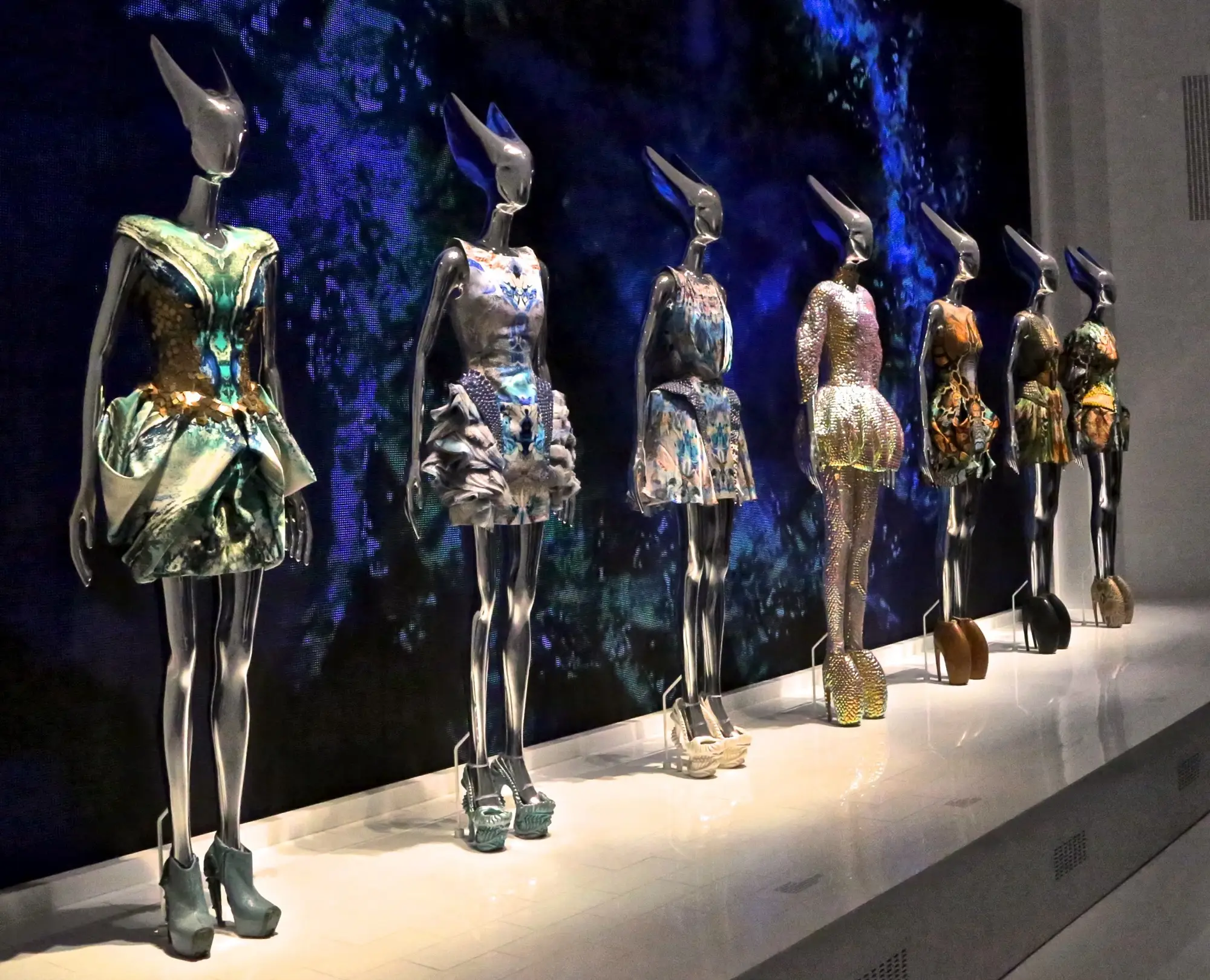
“Plato’s Atlantis” was built on an evolutionary narrative of breathtaking ambition. McQueen envisioned a future in which rising oceans had forced humanity to adapt to aquatic life, a Darwinian reversal in which the species returned to the sea from which it had emerged. The collection’s digitally printed fabrics mimicked the skins of reptiles and marine creatures. Its silhouettes suggested bodies in transition between terrestrial and aquatic forms. And the Armadillo boot — its body compared variously to an armadillo’s shell, a lobster claw, an animal hoof — proposed a foot that had evolved beyond the human, that had fused with its covering into something new and not entirely identifiable. The boot extended the leg into a single unbroken line, like a ballerina en pointe, but the pointe was not a toe. It was a curved, closed form that abolished the foot entirely, replacing anatomy with sculpture. McQueen drew inspiration from the pop artist Allen Jones, from the performance artist and designer Leigh Bowery, and from H.R. Giger’s biomechanical aesthetics — the dark, fused, organic-industrial forms that Giger had developed for the Alien franchise. The Armadillo boot synthesized these references into something that exceeded all of them.
The manufacturing process was as extreme as the design. Each pair required five days to produce and the involvement of approximately thirty people across three factories, drawing materials from three separate suppliers. The inner lining and outer shell were shaped separately and fitted together, a construction method closer to prosthetics or orthopedics than to conventional shoemaking. The wood was hand-carved, meaning each pair carried slight variations — the trace of the carver’s hand in the curve of the shell, in the angle of the heel. McQueen collaborated with the shoe designer Georgina Goodman on the engineering, and the challenge was not merely aesthetic but structural: how to create a shoe of this height and curvature that could be walked in at all, however improbably. The answer was barely. The models on the runway moved with a lurching, deliberate gait that became part of the boot’s meaning — the difficulty of the walk was not a flaw but a feature, a performance of the extremity the shoe demanded. To wear the Armadillo boot was to accept a fundamental renegotiation of the body’s relationship to the ground, and most bodies declined the negotiation.
The show itself was a landmark for reasons beyond the collection. “Plato’s Atlantis” was the first fashion show to be live-streamed globally, a collaboration with the photographer and director Nick Knight via his platform SHOWstudio that anticipated the digital transformation of fashion by at least a decade. The stream crashed under the weight of demand — reportedly accelerated by Lady Gaga tweeting about it to her millions of followers — and the resulting images circulated with a speed and reach that no previous fashion presentation had achieved. Gaga subsequently wore the Armadillo boots in her “Bad Romance” music video, released in November 2009, and that appearance cemented the boots in popular consciousness in a way that a runway presentation alone could not have accomplished. The boots became the visual shorthand for McQueen’s vision — a single image that communicated the ambition, the craftsmanship, and the unearthly strangeness of his work to an audience that had never attended a fashion show and never would.
The Metropolitan Museum of Art holds a pair in its permanent collection, and the boots were prominently featured in “Alexander McQueen: Savage Beauty” — the Costume Institute exhibition that opened at the Met in 2011 and traveled to the Victoria and Albert Museum in London in 2015, where it became the most visited exhibition in the V&A’s history. In the context of that retrospective, the Armadillo boot occupied a position of finality — the last great gesture of a career defined by great gestures, the terminal point of a trajectory that had moved relentlessly toward the extreme. McQueen had always designed shoes that challenged the body: the carved wooden soles of his early collections, the prosthetic legs made for the Paralympic athlete Aimee Mullins in 1999. The Armadillo boot was the logical conclusion of that project, a shoe so extreme that it could not be exceeded, only contemplated. It remains in fashion what the summit is in mountaineering — a point beyond which there is nowhere further to go, only the long way back down.