Alexander McQueen
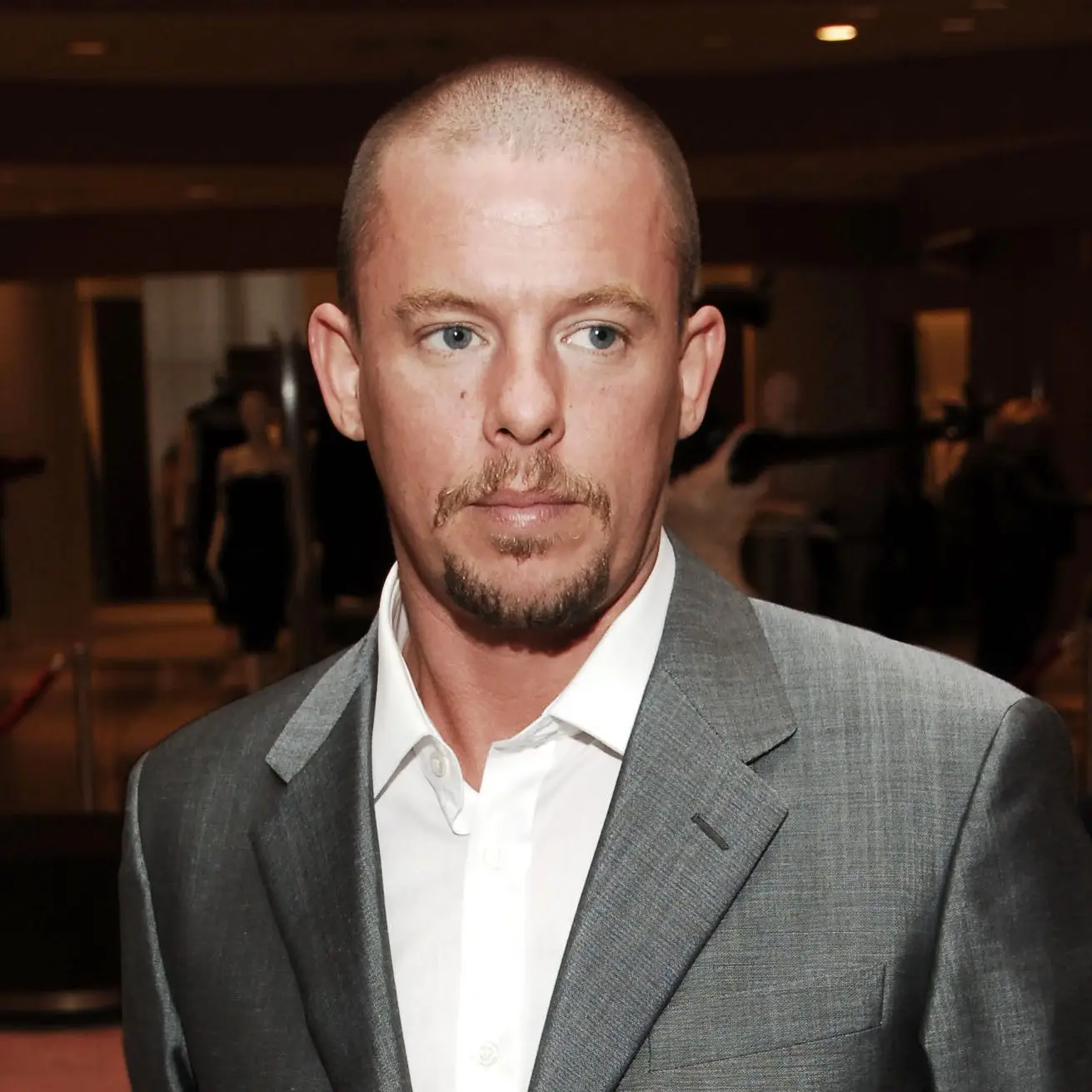
Alexander McQueen began cutting patterns on Savile Row at sixteen. He apprenticed at Anderson and Sheppard, the house known for its soft, draped English tailoring, and then at Gieves and Hawkes, the military tailor, and in those workshops he acquired a technical fluency in garment construction that would underpin every provocation of his subsequent career. The point is essential and frequently overlooked: McQueen was not an enfant terrible who happened to know how to sew. He was a master tailor who chose to use his mastery in the service of ideas that most tailors would have considered beyond the scope of their craft. The precision of the cut was never abandoned, never sacrificed for the sake of the concept. It was the instrument through which the concept was realized, and the tension between traditional craft and radical imagination gave his work its singular force.
He enrolled at Central Saint Martins and completed his MA in fashion design in 1992. His graduation collection, “Jack the Ripper Stalks His Victims,” was bought in its entirety by the magazine editor Isabella Blow, who recognized in the young designer from Lewisham a talent so extreme that conventional categories of evaluation could not contain it. Blow became his patron, his advocate, and his bridge to the fashion establishment, and their relationship — intense, codependent, ultimately tragic — prefigured the emotional extremity that would characterize McQueen’s work for the next two decades. The early collections, produced with almost no budget and shown in spaces that would have been condemned by any health inspector, were already fully formed in their ambition: fashion as theater, the runway as a site of narrative, the garment as a vehicle for stories about power, violence, sexuality, history, and the vulnerability of the body.
The Fall/Winter 1995 “Highland Rape” collection, only his fourth, announced the scale of his intentions. Drawing on the history of English colonization of Scotland — McQueen’s own heritage — the collection presented women in slashed tartan and torn lace, the garments appearing to have been ripped from their bodies by an act of force. The controversy was immediate and fierce, with critics accusing the twenty-six-year-old designer of glamorizing violence against women. McQueen’s response was that the collection was about England’s rape of Scotland, not the assault of individual women, and that the audience’s failure to read the historical reference was their problem, not his. The defense was characteristically combative and not entirely persuasive — the images were powerful precisely because they trafficked in the aesthetics of gendered violence, regardless of their intended referent — but the collection demonstrated that McQueen was willing to provoke at a level that most designers would not risk, and that the provocation was never empty but always in service of a narrative with genuine historical and emotional weight.
His appointment as chief designer at Givenchy in 1996, at the age of twenty-seven, placed him inside the machinery of Parisian haute couture, and the tension between his sensibility and the house’s heritage produced collections that ranged from the electrifying to the contentious. The position confirmed his technical ability — couture demands a level of construction expertise that no amount of conceptual brilliance can fake — but it also revealed the cost of working within institutional constraints that were fundamentally alien to his temperament. He left Givenchy in 2001 and concentrated on his own label, which had been backed by the Gucci Group since 2000, and the subsequent decade produced the work for which he will be most remembered.
The runway shows became immersive theatrical experiences with a production ambition that exceeded anything fashion had previously attempted. A holographic projection of Kate Moss appeared and dissolved in a pyramid of light. A chess match was staged with living pieces. A glass box filled with snow fell on models as they walked. A pair of robotic arms spray-painted a white dress on a spinning model in real time, the mechanical precision of the machines contrasting with the organic vulnerability of the human body. These were not spectacles for their own sake. They were narrative devices, environments constructed to give the garments emotional context, to create the conditions under which a dress was not merely a dress but a character in a story about transformation, destruction, beauty, or death. McQueen understood, more completely than any designer of his generation, that a fashion show could function as a theatrical production, and that the garments shown within it were inseparable from the world in which they were presented.
He won four British Designer of the Year awards — in 1996, 1997, 2001, and 2003 — and the CFDA International Designer of the Year in 2003. He was appointed Commander of the Order of the British Empire. The accolades ratified a career whose importance the industry had recognized from the beginning, even when the work made that industry profoundly uncomfortable. His death on February 11, 2010, at the age of forty, was a shock that the fashion world has not fully absorbed. The Metropolitan Museum of Art’s 2011 retrospective “Savage Beauty” — which broke attendance records at both the Met and the Victoria and Albert Museum, where it subsequently traveled — confirmed the scale of the loss. The exhibition demonstrated that McQueen’s body of work, compressed into fewer than two decades, constituted one of the most complete and emotionally devastating artistic achievements in the history of fashion: the proof that clothing could be as narratively rich as cinema, as emotionally direct as music, and as technically accomplished as architecture, and that the designer who made it possessed a vision so total that every garment, every show, every collaboration was an expression of a single, ferocious intelligence that refused to separate beauty from pain.