Flat Cloth
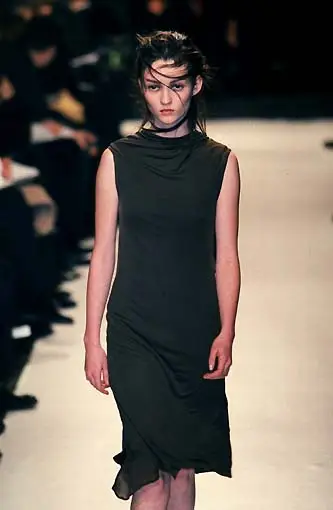
Ann Demeulemeester’s Fall/Winter 1998 collection began, as all her best work began, with a piece of flat cloth. Not a sketch, not a pattern, not a concept articulated in words, but a rectangle of fabric into which she cut holes for the arms, then watched. The watching was the methodology: observing how the material fell, how gravity shaped it against the body, how the cloth’s own weight and drape proposed forms that no pattern-making system could have predicted. From this patient observation, she developed the wrapping techniques that produced the collection’s garments — a process closer to sculpture than to traditional dressmaking, in which the designer’s role was not to impose form on material but to discover the forms that material already contained.
The resulting silhouettes had a fluidity that was instantly recognizable as Demeulemeester’s and no one else’s. Floor-length military coats in heavy black melton wool fell from the shoulders with a weight that was simultaneously protective and elegant, their construction derived not from the rigid geometry of tailoring but from the improvisational logic of draping, so that each coat moved with the body rather than constraining it. The military references — present in the cut of the coats, in the hardware of the closures, in the stance the garments encouraged the wearer to adopt — were filtered through a sensibility so romantic that the aggression dissolved into something more ambiguous: garments that looked like they could protect you, but also like they could hold you, the boundary between armor and embrace deliberately unresolved.
Flowing knit dresses, based on simple rectangles with subtle structural details, created asymmetrical silhouettes that defied the bilateral symmetry of conventional fashion. The asymmetry was not decorative — it emerged from the construction itself, from the way a single structural intervention, a dart placed here rather than there, a seam angled at an unexpected degree, could transform a rectangle of fabric into a garment that wrapped the body with an intimacy that fitted clothing could not achieve. Pieces featured back panels that could be fastened or unfastened via push buttons, transforming the garment’s shape at the wearer’s discretion — a practical detail that carried conceptual weight, suggesting that a garment’s form was not fixed but negotiable, that the relationship between cloth and body was a conversation rather than a decree.
A notable accessory embodied the collection’s gender-blurring impulse: a man’s shoe form mounted on a high heel, a hybrid object that refused to resolve into either masculine or feminine footwear and that captured, in a single object, the androgynous sensibility that had governed Demeulemeester’s work since the beginning. She had been among the first designers to present men’s and women’s collections together, in 1996, and the FW98 collection extended this integration not through unisex garments — a concept she would have found reductive — but through a construction philosophy that did not distinguish between male and female bodies, that began with flat cloth and let the cloth decide what forms it wanted to take, regardless of the gender conventions that fashion normally imposed.
The collection was shown in Paris at a moment when the Belgian avant-garde was at the height of its influence — Margiela, Demeulemeester, and Dries Van Noten all producing important work simultaneously, all showing in Paris, all demonstrating that Antwerp’s Royal Academy had produced not a single generation of interesting designers but a permanent alternative to the Paris-Milan-New York axis. Within this constellation, Demeulemeester’s position was distinctive. Where Margiela deconstructed garments intellectually, exposing their construction as a form of philosophical inquiry, and where Kawakubo distorted them conceptually, using the body as a site for abstract investigation, Demeulemeester approached construction as an emotional and physical process — feeling her way to new forms rather than theorizing them. The results were garments that carried intellectual weight precisely because they did not announce their intelligence, that were avant-garde not because they looked difficult but because their methodology was genuinely original, and that achieved a beauty so quiet, so uninsistent, that you could mistake it for simplicity if you were not paying attention. The FW98 collection rewarded attention. Every piece revealed, upon close examination, the care and precision of its making — the way the fabric had been guided rather than forced, the way the silhouette emerged from the material’s own inclinations, the way the garment seemed not to have been designed but to have arrived, fully formed, from a process that was part craft, part intuition, and part the willingness to let cloth be cloth.