Broken Bride
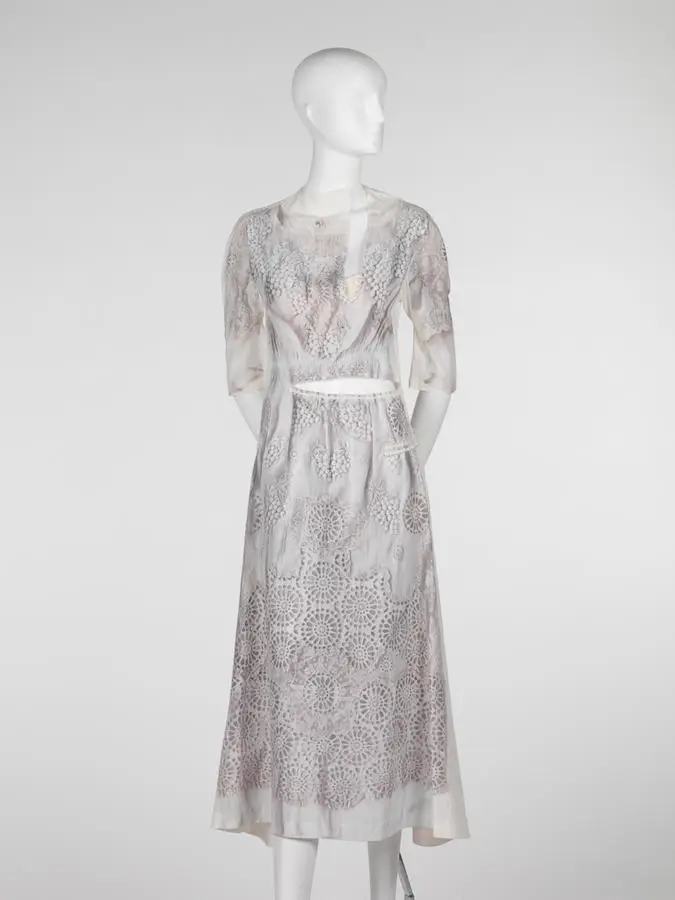
Rei Kawakubo declared the Fall/Winter 2005 collection was about anti-conservatism through nuptial rites, and the statement, characteristically compressed, contained the entire conceptual architecture of what followed. The “Broken Bride” collection presented wedding dresses — the most conservative, most ritualized, most symbolically loaded garments in the Western wardrobe — and then fractured them. Not destroyed them, not deconstructed them in the analytical manner of Margiela, but fractured them with the specific care of someone who understands that a thing must be beautiful before its breaking can mean anything. The garments were romantic, Victorian-inspired, elaborate in their construction: silk dresses, lace bodices, full skirts, the entire vocabulary of bridal fantasy rendered with a technical accomplishment that demonstrated Kawakubo’s mastery of the traditions she was subverting. And then the damage.
But the damage was not real. This was the collection’s most sophisticated gesture: the silk dresses bore imprinted patterns of Victorian bows, lace, wrinkles, crushed bows, stains, and faded lace — not actual damage but photographic prints of damage, trompe-l’oeil decay applied to pristine fabric. The garments were simultaneously new and old, fresh and deteriorated, present and past. The stains did not penetrate the cloth. The wrinkles did not distort the surface. The fading was an image of fading, not the thing itself, and this distinction between real decay and the representation of decay opened a conceptual space that was far more interesting than simple destruction could have achieved. A torn wedding dress is a cliche. A wedding dress that bears the printed image of its own future deterioration is something else entirely — a meditation on time, on the inevitable collapse of beauty, on the gap between the thing and its image, between the present moment and the future it already contains.
Asymmetric convertible jackets in black wool gabardine and silk chiffon appeared alongside the bridal pieces, their lace and ribbon appliques connecting them to the collection’s nuptial vocabulary while their severity pulled them toward something harder, more urban, more resistant to sentiment. The palette moved between white and black, between the bride’s purity and the widow’s mourning, between the beginning of the marriage and the end of it, and the garments that occupied the space between these extremes — the grey silks, the off-whites, the blacks tinged with color — suggested a timeline of romantic decay compressed into a single showing. The silhouettes were Kawakubo’s: sculptural, sometimes distorted, always operating at a distance from the body that prevented the garments from becoming mere costumes. These were not wedding dresses to be worn at a wedding. They were arguments about what a wedding dress means — about the conservatism encoded in bridal ritual, about the fantasy of permanence that a white dress represents, about the violence that time inflicts on every beautiful thing.
What distinguished “Broken Bride” from Kawakubo’s more austere conceptual work — the Lumps and Bumps collection’s bodily distortion, the later collections’ progressively abstract forms — was its emotional directness. The collection engaged with romance, sentimentality, and beauty not as targets of critique but as raw materials to be transformed. Kawakubo was not mocking the bride or dismissing bridal fantasy. She was taking it seriously enough to examine what happens to it when time passes, when the dress yellows, when the lace tears, when the stain appears and cannot be removed. The result was a body of work that was simultaneously beautiful and melancholy, celebratory and elegiac, and the emotional complexity of this dual register gave the collection a resonance that purely conceptual work rarely achieves. Pieces entered the permanent collection of the Metropolitan Museum of Art, and they remain highly coveted by collectors, their value sustained by the emotional precision of their conception.
The “Broken Bride” occupies a specific position in Kawakubo’s career: a mid-career demonstration that her conceptual approach could produce garments of extraordinary beauty alongside intellectual provocation. It answered, with devastating clarity, the criticism that had dogged her since the 1981 Paris debut — that her work was too cerebral, too austere, too willfully ugly to qualify as fashion in any meaningful sense. The broken brides were none of these things. They were tender. They were gorgeous. They were, in their damaged and time-worn splendor, the most beautiful garments Kawakubo had ever produced. And they achieved that beauty not despite their brokenness but because of it — because Kawakubo understood, as the Romantics had understood two centuries earlier, that beauty without the knowledge of its own impermanence is not beauty at all but merely prettiness, and that the difference between the two is the difference between something that decorates a life and something that illuminates it.