Lumps Dress
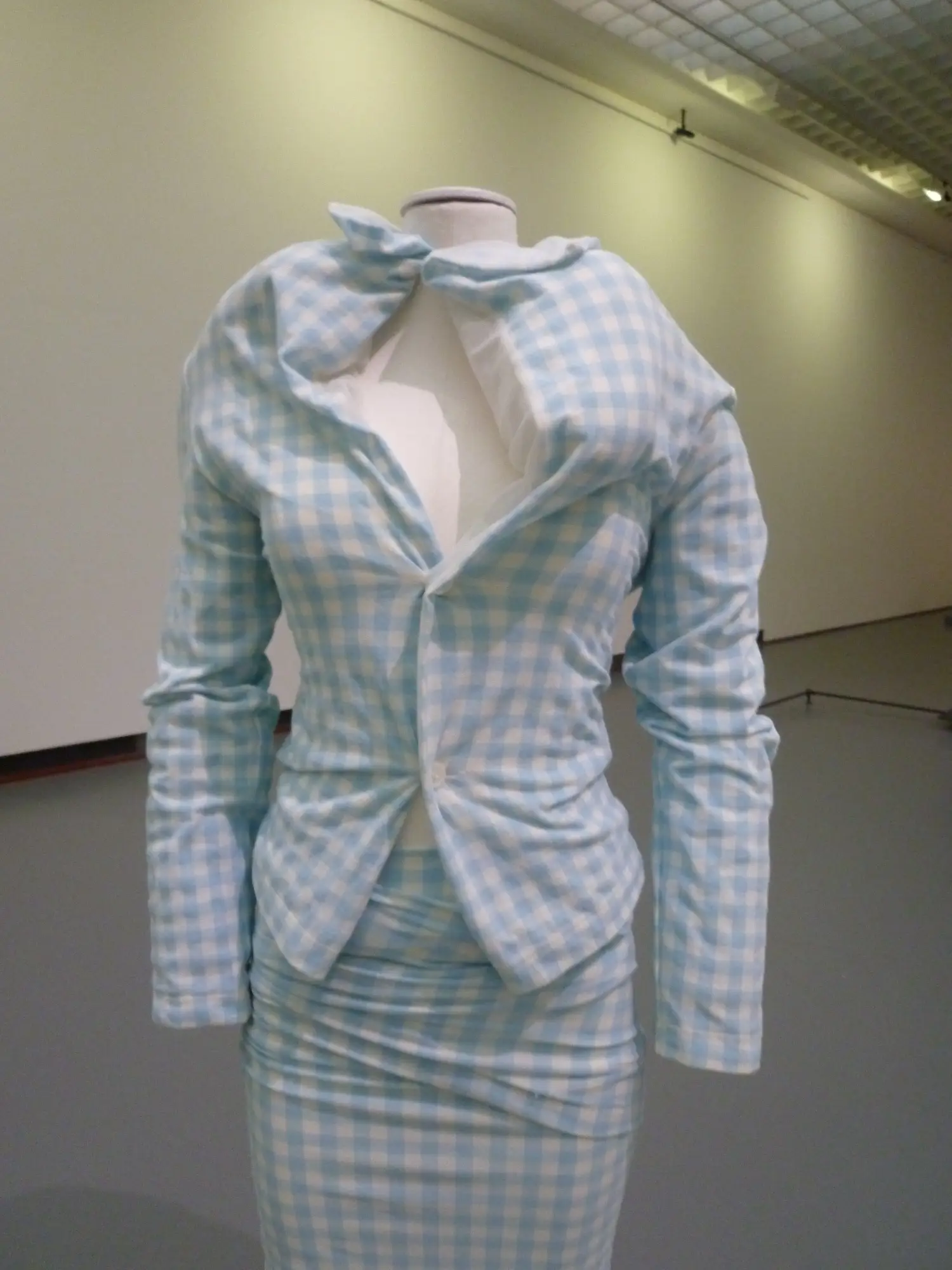
A dress that asked whether beauty could exist in the distortion of the human form.
The Lumps Dress is the most immediately recognizable garment from Rei Kawakubo’s Spring/Summer 1997 “Body Meets Dress, Dress Meets Body” collection — a gingham-check dress in stretch nylon with asymmetric bulges of polyurethane padding inserted between its layers. The protrusions appear at the hip, the shoulder, the small of the back — locations that bear no relationship to conventional ideas about where a woman’s body should curve. The effect is visceral. The dress does not flatter the body. It replaces it with something else: a new form, a new silhouette, a new set of questions about what a body is and what clothing does to it. In 1997, Parisian fashion was still governed by the supermodel’s proportions, by the assumption that clothing existed to celebrate a body everyone already agreed was beautiful. Kawakubo’s response was to suggest that the agreement itself was the problem.
The construction is deceptively simple and deliberately uncanny. Each dress in the collection featured a unique silhouette created by the strategic placement of polyurethane and down-filled pads between layers of stretch nylon. The pads were positioned at the abdomen, the hips, the back, and the shoulder, sculpting the body into shapes that evoked what one critic described as Punchinello proportions — the hunchbacked commedia dell’arte figure whose deformity was his identity. In some versions the pads were removable, and fashion editors reported that certain store clerks displayed the dresses without them, as though the garments needed to be rescued from their own intentions. This impulse to normalize the dress, to strip it of its strangeness and return it to a shape the market could understand, was itself evidence of what the dress was working against. The padding was not an accessory to the garment. It was the garment’s argument.
Kawakubo chose gingham for reasons that compounded the dress’s strangeness. The fabric carries associations with domesticity, with childhood, with a particular vision of wholesome femininity — Dorothy’s dress, the picnic tablecloth, the schoolgirl’s uniform. To take this fabric and stretch it over padding that deformed the body was to short-circuit a chain of comfortable associations and arrive somewhere deeply uncomfortable. The gingham pattern, distorted by the padding underneath, warped and stretched in ways that made the garment’s internal structure visible — the flat, regular check becoming a map of the three-dimensional forms hidden beneath. Other colorways in the collection — pale pink, baby blue, solid black, navy, and white — operated along the same axis of subversion, pairing innocuous surface with radical form. But it was the gingham that cut deepest, because it made the distortion impossible to aestheticize as abstraction. You knew what gingham was supposed to look like, and this was not it.
The press response was immediate and polarized in ways that revealed more about the press than about the collection. Critics compared the pads to tumors, to pregnancy, to deformity — reaching for the pathological because they had no other vocabulary for a silhouette that refused to organize itself around desirability. Kawakubo rejected all literal readings. Her stated intent was disarmingly direct: she wanted to rethink the body so the body and the dress became one. This was not metaphor but method. The collection proposed that a dress could be a body — not a covering for one, not a frame around one, but a body in its own right, with its own topology, its own logic of protrusion and concavity. The idea had precedents in sculpture, in prosthetics, in the history of the corset and the bustle. But Kawakubo was not interested in precedent. She was interested in discomfort, and in the possibility that discomfort might be a more honest aesthetic category than beauty.
The collection was received as more gallery object than garment, and very few pieces were worn publicly as everyday fashion. This fact is often cited as evidence of the collection’s impracticality, but it might equally be cited as evidence of its precision. Kawakubo made exactly the thing she intended to make, and the world’s reluctance to wear it was not a failure of the design but a confirmation of its thesis. The 2017 Metropolitan Museum of Art retrospective “Rei Kawakubo/Comme des Garcons: Art of the In-Between” — only the second Costume Institute exhibition devoted to a living designer, after Yves Saint Laurent — placed the Spring/Summer 1997 pieces at the center of its argument. The “Object/Subject” gallery focused specifically on these dresses, positioning them as the fulcrum of Kawakubo’s career, the moment at which her interrogation of the body became irreversible. Approximately one hundred and forty works were shown in total, spanning from the early 1980s to 2017, and yet it was the padded gingham that everyone remembered.
The Lumps Dress now resides in the collections of the Museum of Modern Art in New York, the Metropolitan Museum of Art, and the Kyoto Costume Institute, among others. On the rare occasions when original pieces surface on the secondary market, they command prices ranging from several hundred to nearly ten thousand dollars, depending on condition and provenance. Its presence in these institutions confirms what was evident in 1997: this is a proposition as much as a garment, one of the most significant in fashion’s recent history. It asks whether beauty requires the body as we know it, whether clothing must serve the body or can instead transform it, and whether the discomfort provoked by an unfamiliar silhouette is evidence of limitation in the garment or in the viewer. Kawakubo, characteristically, has never provided answers. The dress persists as a question — permanent, padded, and unyielding.