Body Meets Dress, Dress Meets Body
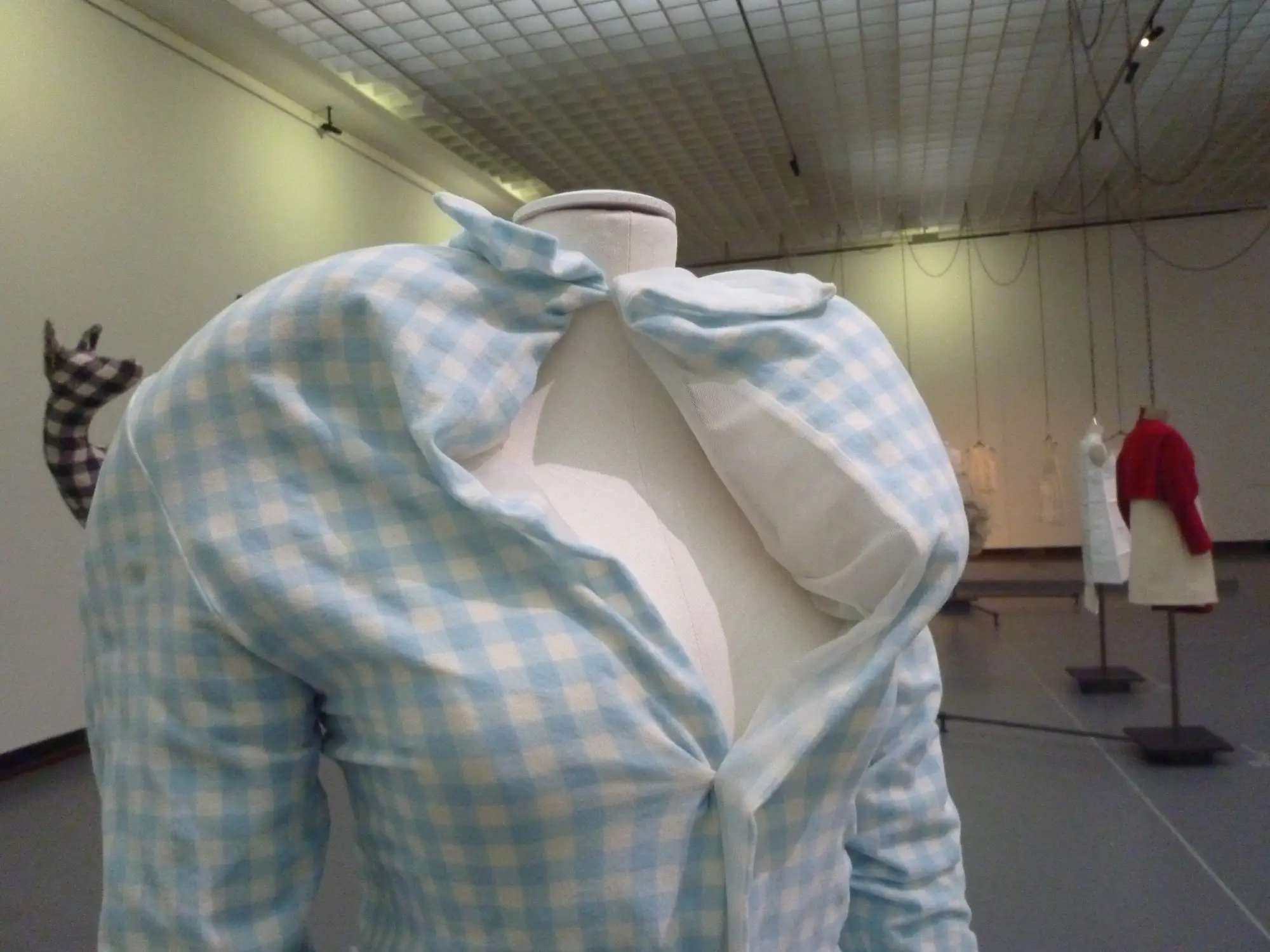
The Lumps collection. The name the press gave it was reductive but not inaccurate — the garments were, visibly and unmistakably, lumpy. Rei Kawakubo had inserted pads of goose-down stuffing between layers of stretch nylon gingham, creating protrusions at the shoulders, hips, back, and belly that distorted the body’s silhouette into something unrecognizable. The effect was not subtle. Models appeared to have growths, pregnancies, humps, extra organs. The body beneath the fabric was no longer the body as fashion understood it. It was something else entirely — a form liberated from anatomy, from desire, from the centuries of accumulated assumption about what a clothed woman should look like. Shown during Paris Fashion Week in October 1996 for the Spring/Summer 1997 season, the collection arrived nearly three decades into Kawakubo’s career and yet operated with the disruptive force of a debut, proof that genuine radicalism is not a phase but a discipline.
The materials were chosen with the precision of someone who understands that conceptual ambition means nothing without material intelligence. Stretch lycra provided the structural skin, conforming to the body’s natural contours while simultaneously accommodating the goose-down insertions that deformed those contours beyond recognition. The gingham — pale pink and baby blue checks, the fabric of tablecloths and children’s pinafores and summer domesticity — added a layer of unsettling familiarity to forms that were profoundly strange. This was not industrial fabric or high-tech innovation. It was the fabric of the ordinary, pressed into the service of the extraordinary, and the dissonance between the material’s homely associations and the silhouettes it was being asked to produce generated a tension that made the garments almost impossible to look away from. Jersey dresses with internal padding created organic, tumor-like protrusions that moved with the body, shifting and settling as the models walked, so that the garments appeared to be alive, breathing, reconfiguring themselves in real time.
Kawakubo’s question was simple and devastating: what if beauty does not require the body we know? Western fashion had spent centuries assuming that the purpose of clothing was to enhance, reveal, or flatter a particular physical ideal — the narrow waist, the long leg, the squared shoulder. The history of silhouette in European dress is a history of strategic emphasis: the bustle exaggerating the posterior, the corset cinching the waist, the shoulder pad squaring the torso, each intervention designed to bring the body closer to an ideal that was always already defined before the garment was made. “Body Meets Dress, Dress Meets Body” rejected every element of that assumption. The padded forms bore no relationship to idealized anatomy. They were placed according to Kawakubo’s own sculptural logic — at the small of the back, on one hip and not the other, in the hollow of the chest — creating silhouettes that were closer to Hans Bellmer’s disarticulated dolls or Henry Moore’s reclining figures than to anything in a fashion magazine. The forms suggested Punchinello, the hunchbacked commedia dell’arte figure, but stripped of his comic pathos and remade as something more dignified: a body that refuses to apologize for its shape.
The collection was polarizing in the way that only genuinely important work can be. Critics were divided between those who recognized it as one of the great artistic statements in fashion history and those who dismissed it as unwearable provocation. Both responses, in their different ways, missed the point. The garments were not propositions about what women should wear. They were propositions about what fashion could think. They asked whether the discipline’s entire framework — the assumption that clothing exists to mediate between the body as it is and the body as it should be — might be fundamentally wrong. What if the garment could propose a body that does not yet exist? What if the relationship between cloth and flesh could be collaborative rather than corrective?
The collection’s afterlife has confirmed its centrality. In October 1997, a collaborative performance titled “Scenario” premiered at the Brooklyn Academy of Music, featuring choreography by Merce Cunningham — one of the twentieth century’s most important choreographers — with dancers wearing Kawakubo’s padded garments against an all-white stage, lit with fluorescent lighting, accompanied by music from Takehisa Kosugi. The partnership between Kawakubo and Cunningham was not merely decorative; it was philosophical. Cunningham’s lifelong project of separating dance from narrative, of treating the body as a formal element rather than a vehicle for storytelling, aligned precisely with Kawakubo’s treatment of the body as a sculptural variable rather than a biological given. Pieces from the collection entered the permanent holdings of the Museum of Modern Art in New York and the Metropolitan Museum of Art, where they featured prominently in the 2017 Costume Institute exhibition “Art of the In-Between.” The Lumps Dress and its siblings have been referenced by designers from Comme protege Junya Watanabe to Iris van Herpen, but the references always feel diminished, approximations of a provocation whose original force derived from Kawakubo’s willingness to risk being ugly in pursuit of a beauty that did not yet have a name.
In the decades since, the collection’s central question remains unanswered, which is exactly how Kawakubo would want it. Fashion has absorbed distortion — McQueen’s bumster, Balenciaga’s volume under Demna, the general loosening of silhouette standards — but it has not absorbed the radicalism of Kawakubo’s proposition, which was not that silhouettes should change but that the very concept of an ideal silhouette should be abandoned. The Lumps collection does not propose an alternative beauty. It proposes that the search for beauty, conducted on fashion’s traditional terms, is itself the problem. That this proposition was made in pale pink gingham, the most innocent of fabrics, is the final provocation in a collection composed entirely of provocations.