Demna Gvasalia
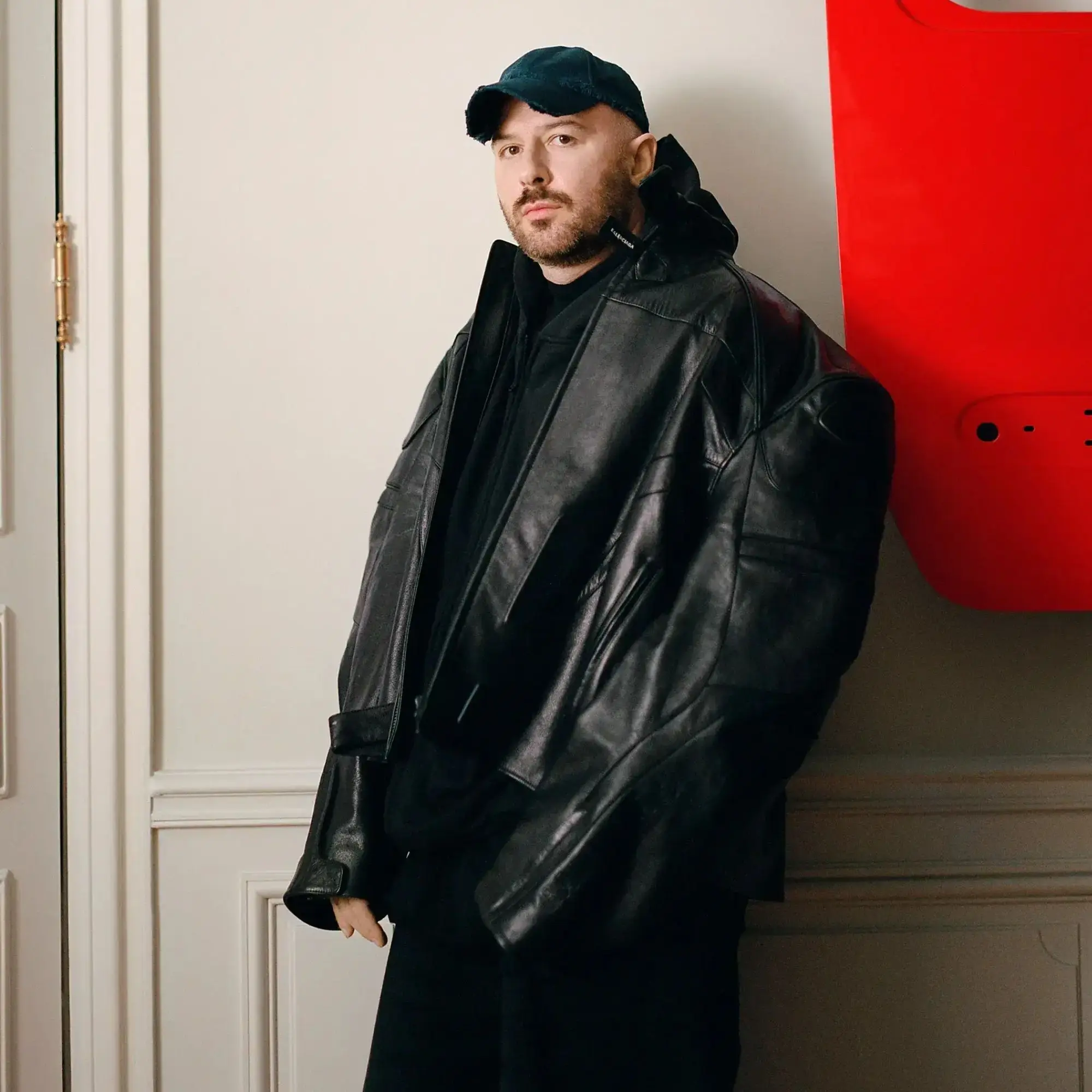
Demna Gvasalia was born in 1981 in Sukhumi, in the Georgian Soviet Socialist Republic, and before he was a teenager he had already lived through the kind of displacement that most fashion designers only reference as aesthetic inspiration. When war broke out in Abkhazia, his family fled, crossing the Caucasus Mountains in a journey that took them through multiple countries before eventually reaching Western Europe. The experience of being a refugee — of losing a home, of carrying everything you own, of navigating systems that were not designed for you — is not incidental to his work. It is the foundation on which everything else is built, the biographical fact that separates his engagement with fashion’s codes and hierarchies from mere intellectual exercise. When Demna deconstructs a garment or subverts a brand, the gesture carries the weight of someone who knows what it means to have the structures you depend on suddenly disappear.
He studied at the Royal Academy of Fine Arts in Antwerp, the same institution that had produced the Antwerp Six and Martin Margiela, and before launching his own project he worked at Maison Martin Margiela — absorbing the house’s methodology of institutional critique, its commitment to anonymity, its insistence that the garment’s construction was as interesting as its surface. But where Margiela operated in the register of philosophical inquiry, producing work that rewarded close reading and quiet contemplation, Demna would apply similar principles at a volume and velocity calibrated for the age of social media, where images travel without context and meaning is generated through repetition, distortion, and the collision of high and low cultural registers.
In 2014, he co-founded Vetements with his brother Guram and a collective of anonymous collaborators, and the brand’s early collections — shown in small gay clubs in Paris, produced with an irreverence that the fashion establishment found either thrilling or threatening depending on its tolerance for being mocked — arrived as a shock to a system that had grown complacent. The proposition was simple and devastating: what if the most mundane objects of contemporary life — a DHL delivery shirt, an oversized hoodie, a pair of jeans worn until they lost their shape — were treated with the same seriousness that fashion reserved for silk and cashmere? The gesture recalled Margiela’s recycled-garment experiments, but where Margiela had found poetry in the discarded, Demna found irony — and irony, deployed with sufficient intelligence and at sufficient scale, proved to be as powerful a tool for disruption as any philosophical framework. Vetements was nominated for the LVMH Young Fashion Designer Prize after just three collections, a recognition that confirmed the industry understood the significance of what was happening even if it could not yet determine whether it was being celebrated or satirized.
The appointment as creative director of Balenciaga in 2015 was the more consequential move. Over the course of nearly a decade, Demna transformed one of fashion’s oldest and most technically distinguished houses into the most talked-about brand in luxury, growing revenues from an estimated three hundred and ninety million dollars to nearly two billion while producing collections that operated simultaneously as fashion, performance art, and institutional critique. The Balenciaga couture collections were the most audacious gestures: the Spring/Summer 2022 show staged as a red carpet with paparazzi, the Fall/Winter 2022 show set in a blizzard-battered landscape, each presentation rethinking not just the clothes but the entire apparatus of fashion display. The Triple S sneaker, with its intentionally ugly, oversized silhouette, became the defining footwear object of the late 2010s — an object that was simultaneously a luxury good, a meme, and a commentary on the absurdity of luxury goods.
His work raises questions that the fashion industry prefers not to confront. What happens when irony becomes the dominant register of luxury? What is the relationship between genuine critique and commercially successful provocation? Can a designer simultaneously deconstruct the logic of a two-billion-dollar brand and benefit from its commercial success without the contradiction invalidating both positions? Demna has not resolved these contradictions, and the refusal to resolve them is, in some sense, the work itself — the demonstration that fashion in the twenty-first century exists in a state of permanent ironic suspension, where sincerity and satire are no longer distinguishable, where a handbag shaped like a trash bag can be simultaneously a joke, a luxury object, and a genuine statement about the arbitrary nature of value.
His 2017 CFDA International Award, given for both Vetements and Balenciaga, confirmed his dual impact on the industry. His departure from Balenciaga and subsequent appointment at Gucci marked the beginning of a new chapter whose implications remain to be seen. But the legacy of his first decade is already clear: Demna inherited Margiela’s institutional critique and demonstrated that it could operate at the scale of global luxury, that deconstruction was not incompatible with commerce but might in fact be the most effective commercial strategy available to a designer intelligent enough to understand that contemporary consumers want to feel both complicit in and critical of the systems through which they consume. The refugee who learned to navigate hostile systems became the designer who learned to navigate fashion’s most hostile system of all — the luxury conglomerate — and in doing so, revealed its mechanisms with a clarity that Margiela, working from the margins, could never have achieved.